


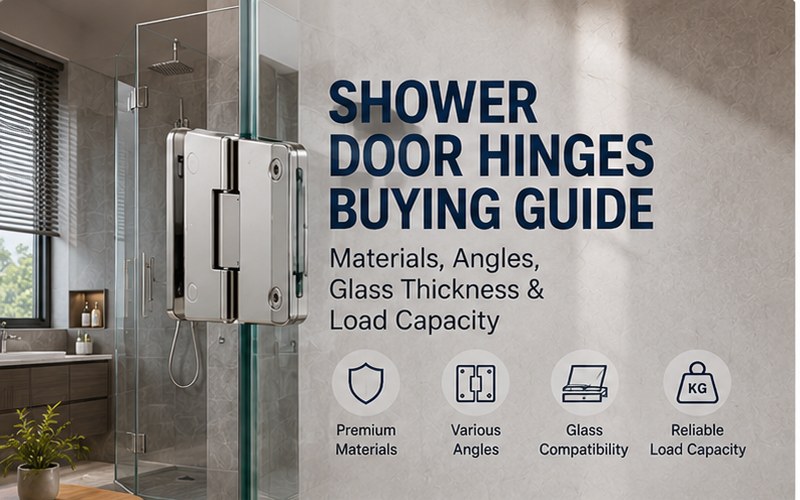
Choosing the right shower door hinges requires matching four main factors: material, hinge angle, glass thickness and actual door load. For most B2B projects, buyers should first determine whether the installation is wall-to-glass or glass-to-glass, then confirm the required 90°, 135° or 180° configuration. Stainless steel shower door hinges, especially SS304 for many indoor applications, are widely used because of their strength and corrosion resistance. However, hinge capacity should never be selected from glass weight alone. Door width, height, hinge quantity and mounting structure also affect performance. Buyers should request technical drawings before glass tempering and verify whether the hinge supports adjustment if installers need to adjust glass shower door hinges after installation.
Start With the Door Layout Before Choosing the Hinge
Many purchasing problems begin because buyers choose a hinge from a photo rather than from the actual shower enclosure layout.
Before comparing models, confirm:
- Is the moving door connected to a wall?
- Is it connected to a fixed glass panel?
- Is the glass arrangement 90°, 135° or 180°?
- Is the door single-action or double-action?
- How thick is the glass?
- What are the door height and width?
- How many hinges will be used?
- Is adjustment required?
These questions narrow the correct types of shower door hinges much faster than starting with surface finish or price.
For B2B projects, this is especially important because one wrong hinge specification can affect dozens or hundreds of tempered glass panels.
1. Choose the Correct Shower Door Hinge Material
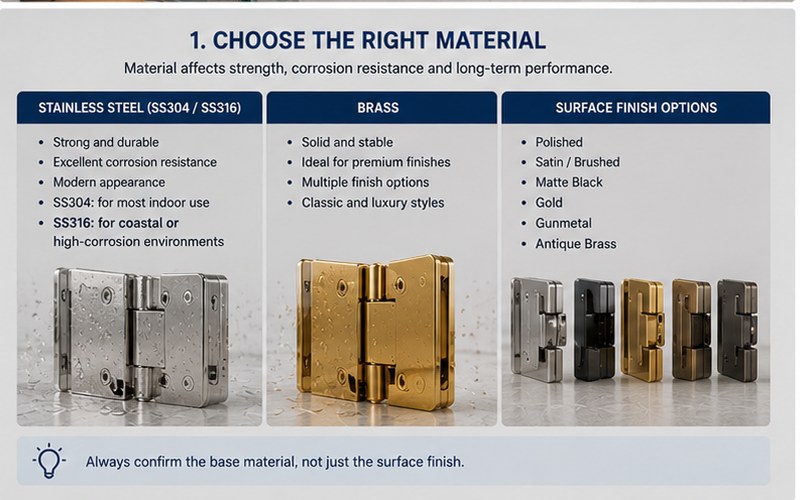
The material affects strength, corrosion resistance, finish consistency and project cost.
Stainless Steel Shower Door Hinges
Stainless steel shower door hinges are widely used in frameless shower systems because they combine mechanical strength with a modern architectural appearance.
For example, SS304 is commonly suitable for many indoor bathroom applications.
Typical uses include:
- Apartments
- Hotels
- Residential bathrooms
- Office shower rooms
- Commercial interiors
By comparison, SS316 may be considered for coastal areas or environments with greater chloride exposure.
For project sourcing, buyers should confirm whether the structural body, pivot, screws and other important components use the specified material rather than assuming the entire product matches the decorative cover.
Brass Shower Door Hinges
Brass hinges are also used in glass shower systems, particularly where buyers require decorative finishes or specific traditional styles.
However, material should not be judged only by appearance.
A chrome, gold or black hinge may use stainless steel, brass or another base metal.
Therefore, always separate:
Base Material
from
Surface Finish
This is important when comparing quotations from different suppliers.
2. Understand the Main Types of Shower Door Hinges
The angle and connection method determine how the moving door relates to the wall or fixed glass.
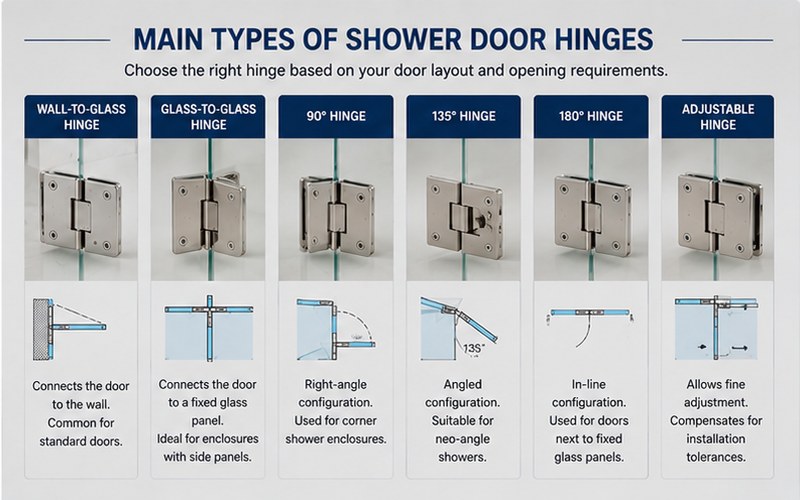
| Hinge Type | Connection | Common Use |
| Wall-to-Glass Hinge | Wall to moving glass | Standard frameless shower door |
| Glass-to-Glass Hinge | Fixed glass to moving door | Shower enclosure with fixed panel |
| 90° Hinge | Right-angle configuration | Corner enclosure |
| 135° Hinge | Angled glass configuration | Neo-angle shower |
| 180° Hinge | In-line glass panels | Door beside fixed glass |
| Adjustable Hinge | Various layouts | Installation requiring correction |
For pivot-style systems, buyers can also review our glass shower door pivot hinges guide before confirming the hardware specification.
Wall-to-Glass Shower Door Hinges
A wall to glass shower door hinge attaches the moving glass directly to a structural wall.
Therefore, the wall must provide adequate support.
For tiled bathrooms, installers should also confirm the substrate behind the tile rather than relying only on the finished surface.
Glass-to-Glass Shower Door Hinges
Glass to glass shower door hinges connect the moving door to a fixed glass panel.
This creates a clean frameless appearance, but the fixed panel must be stable enough to support the transferred door load.
Fixed panels may also use:
- Glass clamps for shower doors
- U-channels
- Shower door support bars
These components should be considered as part of the same system.
3. How to Select the Correct Hinge Angle
Hinge angle is not simply a cosmetic specification.
It determines the relationship between the panels.
90 Degree Shower Door Hinges
A 90 degree shower door hinge is commonly used where the door and fixed glass form a right-angle layout.
For example, this configuration is common in corner shower enclosures.
135 Degree Shower Door Hinges
135° models suit angled shower enclosures, including many neo-angle designs.
The actual glass geometry should be confirmed before ordering because small differences in the layout can affect door alignment.
180 Degree Shower Door Hinges
A 180° configuration normally places the moving door and fixed glass approximately in line with each other.
These are common in larger frameless shower screens and in-line enclosure designs.
Never assume a 90° hinge can simply replace a 135° or 180° hinge because the glass preparation and pivot geometry may differ.
4. Match the Hinge to the Glass Thickness
Common tempered glass thicknesses for shower applications include:
- 8mm
- 10mm
- 12mm
Many glass shower door hinges cover a specified thickness range, but buyers should confirm the exact range before processing the glass.
Why Glass Thickness Matters
The hinge uses gaskets, pressure plates and clamping surfaces designed for a particular glass range.
If the glass is thinner or thicker than specified:
- Gaskets may not compress correctly
- Clamping force may be insufficient
- Screws may not engage properly
- Door alignment may be affected
Therefore, do not assume that a hinge designed for 10mm glass automatically works with 8mm or 12mm glass.
5. Load Capacity Is Not Just Door Weight
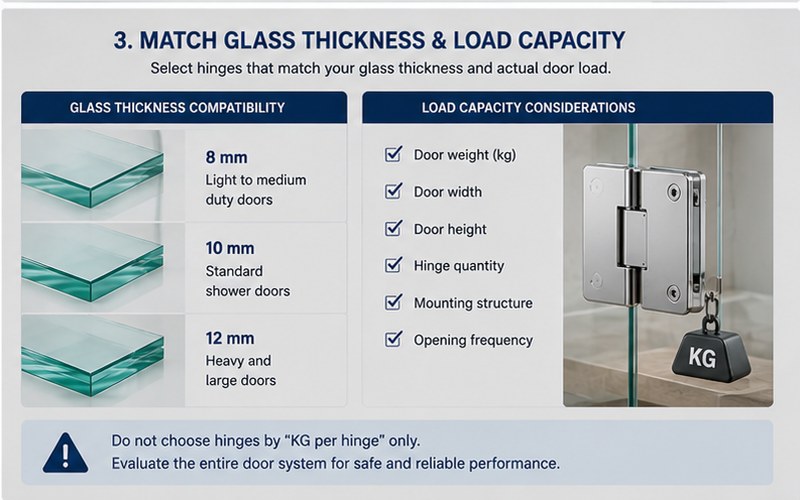
One of the biggest mistakes in B2B procurement is selecting shower door hinges only by the advertised maximum kilogram rating.
However, door weight is not the only factor.
Door Width Creates Leverage
Imagine two glass doors that both weigh 40 kg.
One is narrow, while the other is much wider.
The wider door creates greater leverage on the hinge because the center of mass is farther from the pivot point.
For projects using pivot hinges for glass shower doors, buyers should also evaluate door width, pivot position and the complete load conditions.
Therefore, send the supplier:
Glass thickness + door height + door width + estimated weight + hinge quantity
instead of simply asking:
“Can this hinge support 40 kg?”
Hinge Quantity Must Be Confirmed
Many standard frameless shower doors use two hinges.
However, taller, wider or heavier doors may require three hinges or a different heavy duty shower door hinge.
Adding another hinge without checking the manufacturer’s recommended positioning is not always enough.
The complete door geometry should be evaluated.
6. Decide Whether Adjustment Is Necessary
Not every project needs adjustable hardware.
However, large hotel and apartment projects often experience small differences in walls, tiles and installation positions.
In these situations, adjustable shower door hinges may help installers fine-tune alignment.
Buyers researching how to adjust glass shower door hinges should ask the supplier exactly what adjustment the model provides.
Possible functions include:
- Closing-angle correction
- Door alignment
- Limited rotational adjustment
- Position correction
In addition, the adjustment range varies by hinge design.
A hinge that offers minor alignment correction should not be used to compensate for incorrectly drilled glass or seriously uneven walls.
7. Confirm the Glass Cut-Out Before Tempering
This is one of the most expensive mistakes to make.
Tempered glass generally cannot be drilled or cut again after tempering.
Before placing the glass order, request:
- Hinge dimension drawing
- Glass cut-out drawing
- Hole diameter
- Hole center distance
- Glass-edge distance
- Recommended glass thickness
- Hinge installation orientation
However, two frameless shower door hinges may look almost identical but use different cut-outs.
If a project changes suppliers after the glass has already been processed, compare the drawings before assuming the replacement hinge will fit.
8. Coordinate the Hinge With the Complete Shower Hardware System
The hinge should not be selected independently from other shower door hardware.
Shower Door Handles
Shower door handles should match the hinge finish and glass layout.
Glass Clamps
Glass clamps for shower doors help secure fixed panels and can affect the stability of glass-to-glass installations.
Shower Door Support Bars
For larger fixed glass panels, shower door support bars can provide additional stability.
Shower Door Seals
Shower door seals influence the closing gap and water control around the door.
An incorrectly planned seal can create excessive resistance when the door closes.
Shower Sliding Systems
Where there is insufficient space for a swing door, shower sliding systems may be more practical than hinged hardware.
These related products are useful internal-link opportunities for a shower hinge buying guide.
9. Use a Simple B2B Buying Checklist
Before approving a bulk order, use a consistent specification sheet.
| Buying Factor | What to Confirm |
| Installation | Wall-to-glass or glass-to-glass |
| Angle | 90°, 135°, 180° |
| Glass | Tempered glass thickness |
| Door Size | Height and width |
| Load | Approximate door weight |
| Hinge Quantity | Two, three or project-specific |
| Material | SS304, SS316, brass or specified material |
| Adjustment | Required or fixed |
| Finish | Mirror, satin, black, gold, etc. |
| Glass Processing | Cut-outs and holes |
| Related Hardware | Handle, clamp, support bar, seal |
| Documentation | Drawings and installation guidance |
For large projects, buyers should also test a complete door sample before mass production.
10. Avoid the Cheapest-Hinge Trap
Ultimately, unit price matters, but total project cost matters more.
A cheaper hinge can become expensive if it causes:
- Replacement glass
- Extra installation labor
- Door misalignment
- Finish complaints
- Early replacement
- Project delays
B2B buyers should compare:
Hardware cost + installation efficiency + service life + replacement availability + supplier support
rather than simply comparing the price per hinge.
AOYU HARDWARE supplies shower door hinges, stainless steel shower door hinges, glass-to-glass hinges, wall-to-glass hinges, shower door handles, glass clamps, shower door support bars, shower sliding systems and related shower door hardware for B2B projects.
Providing the glass thickness, door dimensions, installation layout and required finish before ordering helps reduce specification errors and makes product selection more accurate.
FAQ: Questions B2B Buyers Really Ask About Shower Door Hinges
1. I have 10mm tempered glass. Is that enough information to choose the hinge?
No. The supplier should also know the door height, width, approximate weight, installation type and hinge quantity. Two 10mm glass doors can require different hinges if their dimensions are different.
2. Can I use the same shower door hinge for 8mm, 10mm and 12mm glass?
Only if the manufacturer specifies that the hinge supports the complete 8–12mm range. The gasket and clamping structure must match the glass thickness.
3. My door weighs 45 kg. Can two hinges support it?
Possibly, but weight alone is not enough to confirm. Door width, height, hinge spacing and installation structure also affect the load. Send the complete glass dimensions to the supplier before ordering.
4. Can I replace a 90° shower hinge with another brand without changing the glass?
Not necessarily. Different brands can use different hole positions, glass cut-outs and pivot geometry. Compare both technical drawings before replacing the hardware.
5. Should I choose adjustable hinges for every shower door project?
For projects with limited site tolerance, adjustable hinges can be useful, while fixed hinges can work well in accurately standardized installations. Choose based on the actual project requirements.
6. What information should I send a supplier for an accurate quotation?
Send the glass thickness, door height and width, quantity, installation type, hinge angle, required finish and project environment. A drawing or installation photo can make the recommendation more accurate.