



A no dig floor spring is usually the better choice when the site already has finished tiles or marble, the customer wants to avoid floor damage, and the glass door weighs less than about 100 kg. It suits office partitions, smaller retail entrances, meeting-room doors, and renovation projects because installation and future maintenance are relatively simple. A traditional floor spring is generally better for heavier, wider, or higher-frequency glass doors used in hotels, shopping malls, commercial lobbies, and large entrances. Its main disadvantage is installation: contractors must prepare a pit to conceal the body below the floor. The better system therefore depends on door weight, floor condition, traffic frequency, project stage, and maintenance needs rather than appearance alone.
1. What Is a No-Dig Floor Spring?
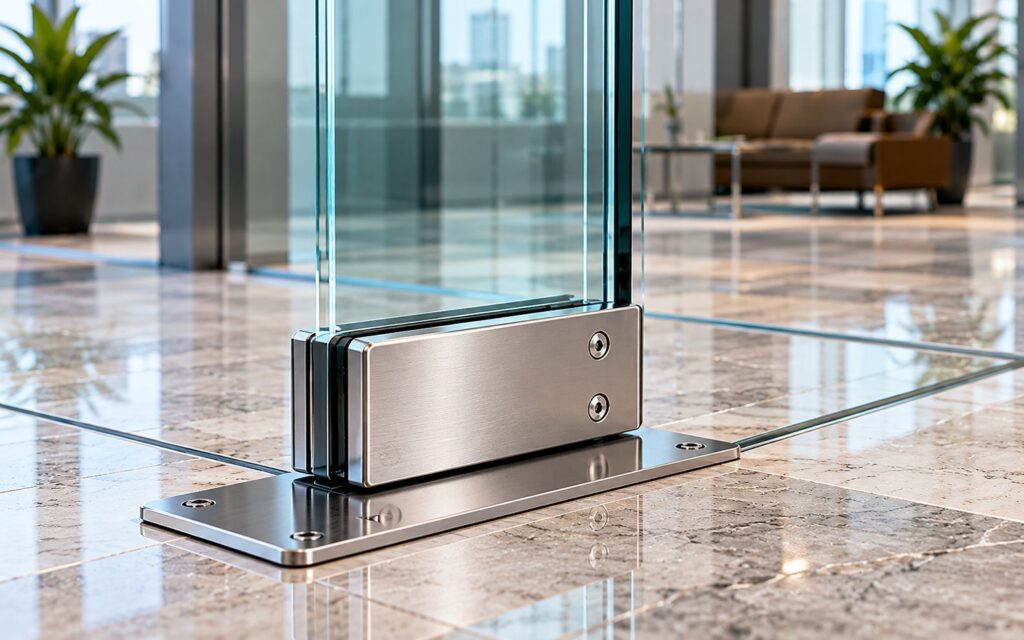
A no dig floor spring avoids the deep excavation required by a conventional concealed closer. It is especially useful after marble, porcelain tile, or other finished flooring is complete, because cutting the floor can create replacement costs, dust, waterproofing risks, and project delays.
Where No-Dig Models Work Best
Typical applications include office glass partition doors, meeting rooms, smaller shop entrances, indoor frameless glass doors, and renovations. Without a deep floor cavity, site work is faster and future access is easier, making the system useful in occupied buildings or where finished flooring must remain intact.
2. The Main Limitation: Door Weight
The main limitation is capacity. Many no-dig models on the market have a maximum door weight rating of approximately 100 kg. That makes them practical for standard office and light commercial doors, but not ideal for oversized or very heavy glass. If the door weight exceeds 100 kg, buyers should generally avoid a standard no-dig model unless the supplier provides a specifically rated heavy-duty version.
Buyers should take extra care with thick tempered glass, laminated glass, wide doors, exterior entrances facing strong winds, hotel lobbies, and shopping mall doors. Easy installation is useful, but it should never replace correct load selection. A closer that is undersized may struggle to control the door, close inconsistently, or wear faster in high-frequency service.
3. Why Finished Tile and Marble Favor No-Dig Installation
For renovation projects, installation cost can matter more than the hardware price. If the contractor has already installed marble or tile, a traditional unit may require cutting the surface, excavating below it, repairing waterproofing, replacing damaged pieces, and refinishing the floor-box area.
Common B2B Pain Point: Comparing Only Unit Price
Many buyers compare only product price and discover the real installation cost later. For an existing office or shop, the no-dig option can reduce disruption and floor damage. Compare hardware, labor, floor repair, downtime, maintenance access, and future replacement—not only the unit price.
4. What Is a Traditional Floor Spring?
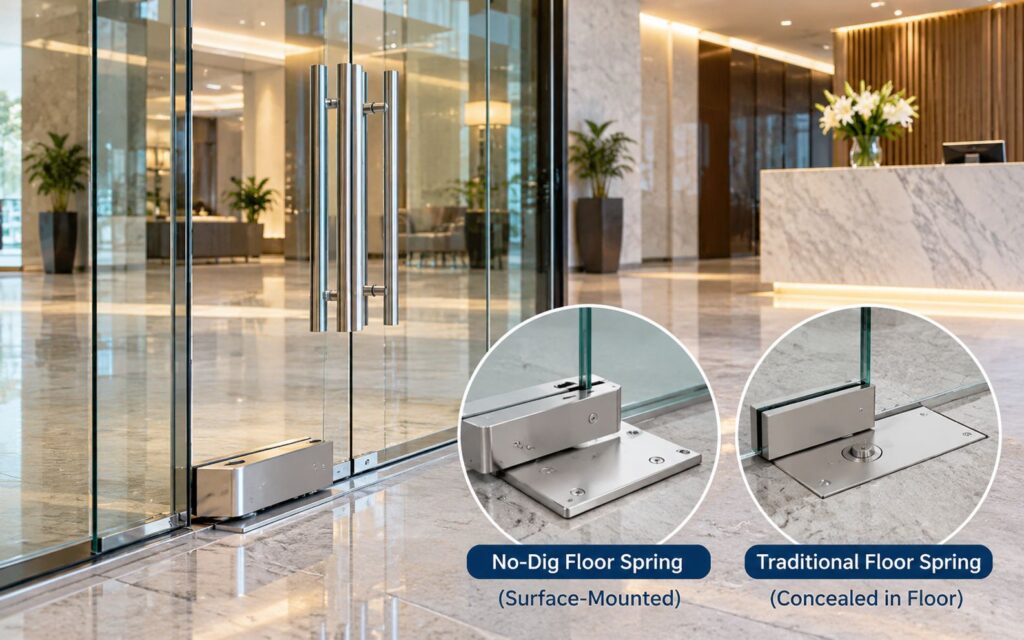
A traditional floor spring sits inside a floor box below the finished floor, leaving mainly the stainless steel cover plate and spindle visible. This concealed format is widely used in hotels, shopping malls, office buildings, commercial lobbies, and large retail entrances.
Installation is more complicated because the contractor must prepare a pit of the correct depth and position. However, traditional models are available in a wider range of heavy-duty capacities. When contractors plan the project during construction, they can position the floor box before installing the tile or marble. This removes much of the installation disadvantage.
5. Why Traditional Floor Springs Suit Heavy and High-Traffic Doors
A large glass door creates more demand on the closing mechanism because of both weight and leverage. Hotels and shopping malls also introduce another factor: opening frequency. A lobby door may operate hundreds of times per day, so long-term durability, hydraulic control, and stable closing become more important than easy installation alone.
For these projects, buyers should confirm door weight, door width, expected cycles, opening angle, closing-speed adjustment, final latching control, wind pressure, and whether the entrance uses one or two leaves. Buyers should select a floor spring for glass door applications as part of the complete door system rather than relying on one headline load number.
6. No-Dig vs Traditional Floor Spring: Practical Comparison
| Feature | No-Dig Floor Spring | Traditional Floor Spring |
| Floor work | No deep excavation | Underground floor box required |
| Finished tile / marble | Very suitable | May require cutting and repair |
| Typical market capacity | Often up to about 100 kg | Available for heavier doors |
| Installation speed | Faster | More complex |
| Maintenance access | Relatively easy | More work around the floor box |
| Renovation projects | Excellent choice | Less convenient |
| Office partition doors | Very suitable | Suitable |
| Hotel / mall entrances | Limited by weight and duty | Common application |
| Heavy glass doors | Not the first choice | Usually better suited |
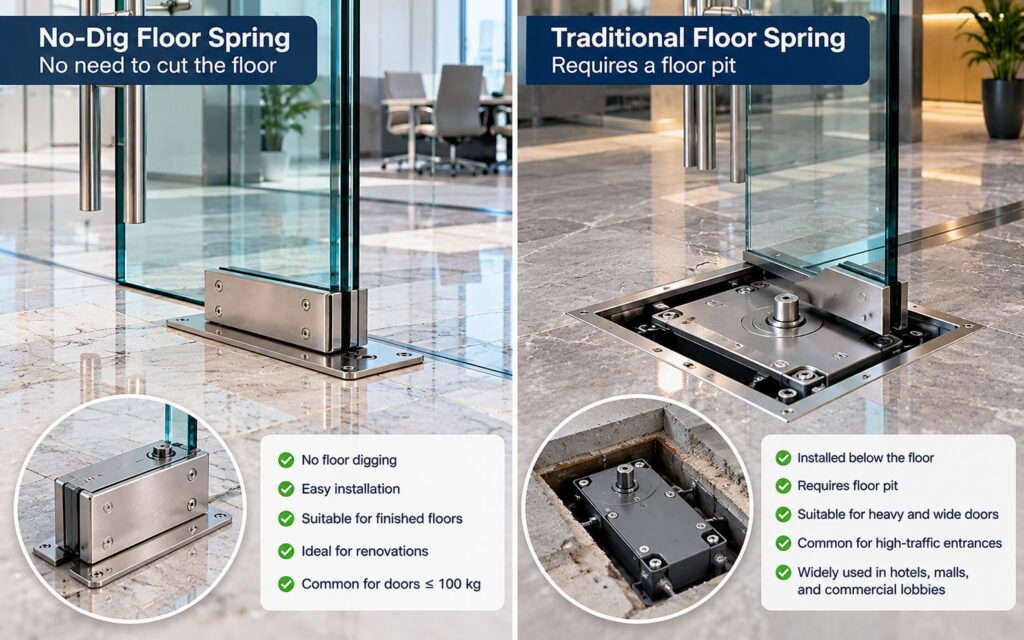
These values are practical purchasing references, not universal engineering limits. The actual rated capacity and permitted door width should always follow the manufacturer’s technical specification and the conditions of the project.
7. Maintenance and Replacement Are Different
A no-dig system is attractive because adjustment, inspection, and replacement are easier to access. This is valuable in offices, shops, meeting rooms, and rented commercial spaces where long shutdowns are unacceptable and future replacement should cause minimal floor disruption.
A traditional floor spring can also be serviced, but replacement may involve more work around the cover and floor box. In a hotel or shopping mall, this extra maintenance effort may still be acceptable because the project benefits from heavier-duty choices and long-term operating stability.
8. Match the Floor Spring With Related Glass Door Hardware
A floor spring does not operate alone. A complete frameless door may also use a top patch fitting, bottom patch fitting, pivot fitting, glass door handle, glass door lock, glass door connector, and other frameless glass door hardware. Buyers should check these related products together because spindle interfaces, pivot centers, opening direction, and glass cut-outs affect compatibility.
Check Patch Fitting Compatibility Before Glass Production
With a traditional system, the bottom patch fitting connects directly with the floor spring spindle. The top patch and upper pivot must also remain on the same centerline. Before production, B2B buyers should confirm the floor spring model, bottom patch interface, top pivot, opening direction, and technical drawing. A mismatch discovered after the glass has been tempered can require replacement hardware or even new glass.
9. What Information Should B2B Buyers Send Before Ordering?
A supplier can recommend the correct no dig floor spring or traditional model much faster when the inquiry includes complete technical information. Buyers should provide glass thickness, door height, door width, approximate door weight, single- or double-door configuration, indoor or outdoor location, expected opening frequency, finished-floor condition, preferred installation method, and any existing patch fitting or pivot details.
For renovation projects, clearly state whether marble or tile is already completed and whether cutting the floor is allowed. For hotel, mall, or large commercial entrances, include the expected traffic level and whether the door is exposed to wind or pressure differences. These details reduce wrong-model orders and prevent the supplier from making assumptions from a product photo.
10. Which Floor Spring Should You Choose?
Choose a no dig floor spring when the finished floor should not be damaged, installation speed matters, maintenance access is important, and the door is within the model’s rated capacity. For many standard market products, doors under about 100 kg are the most suitable range. This makes the system especially practical for office partitions, meeting rooms, smaller shops, and renovation projects.
Choose a traditional floor spring when the project uses a heavier or wider glass door, requires higher traffic durability, or is being coordinated during the original construction stage. Hotels, shopping malls, commercial lobbies, and oversized glass doors usually benefit more from a concealed traditional system because heavier-duty specifications are available.
Conclusion
The decision between a no dig floor spring and a traditional floor spring should not be based only on hardware price. A no-dig system solves one of the biggest renovation problems: adding a glass door without seriously damaging finished tile or marble. It is simple to install, convenient to maintain, and well suited to lighter office, retail, and partition doors.Traditional floor springs require more construction work because the body is installed below the floor, but they remain the stronger choice for many heavy, wide, and high-frequency commercial doors. For B2B buyers, the safest process is to confirm door weight, width, floor condition, traffic level, installation method, and matching glass door patch fittings before placing an order. Clear specifications reduce installation problems, unexpected construction costs, compatibility errors, and future replacement risk.