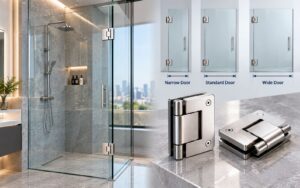


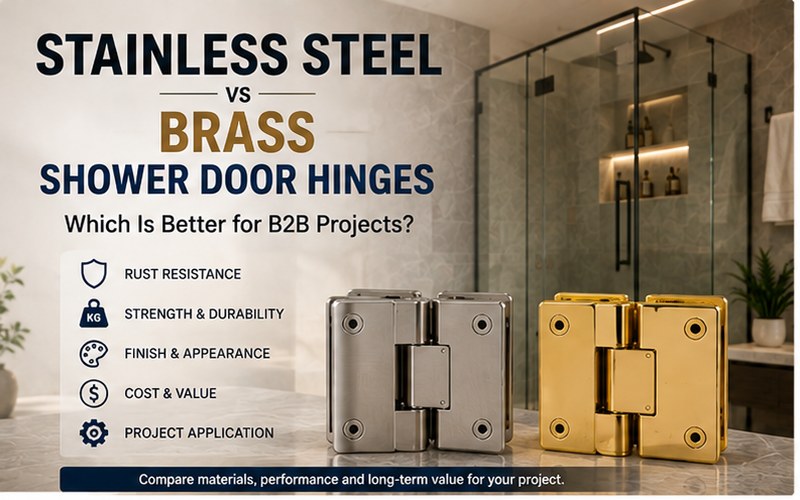
For most B2B projects, neither stainless steel nor brass shower door hinges are automatically “better” in every situation. Stainless steel shower door hinges are often preferred when buyers prioritize structural strength, corrosion resistance, modern finishes and standardized project supply. Brass hinges, meanwhile, can be an excellent option when premium decorative finishes, traditional hardware styling or specific machining requirements are important. The right choice depends on the installation environment, hinge structure, door dimensions, surface finish, order quantity and project budget. Buyers should also confirm whether the hinge is solid stainless steel or solid brass rather than judging only by the external finish. For hotels, apartments and commercial shower projects, material consistency and supplier quality control can matter as much as the base metal itself.
Stainless Steel vs Brass Shower Door Hinges: Quick Comparison
For project buyers, the easiest way to begin is to compare the two materials against the actual project requirements.
For a broader comparison of materials, hinge angles, glass thickness and load capacity, see our complete shower door hinges buying guide.
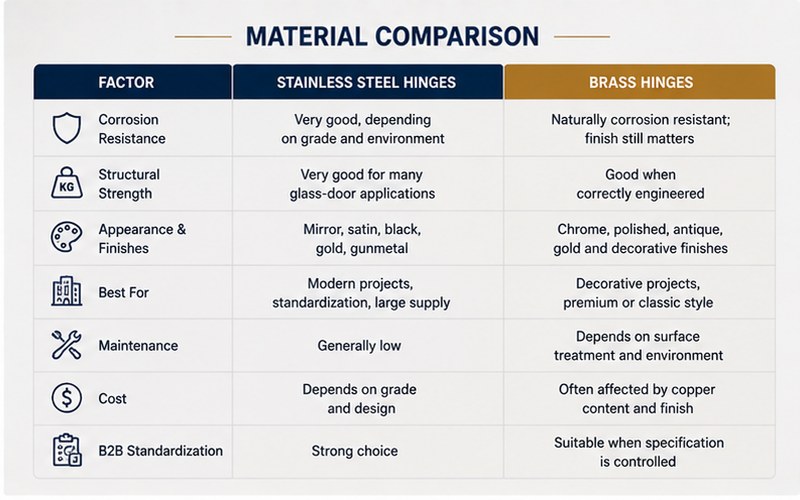
| Factor | Stainless Steel Hinges | Brass Hinges |
| Structural Strength | Very good for many glass-door applications | Good when correctly engineered |
| Corrosion Resistance | Very good, depending on grade and environment | Naturally corrosion resistant; finish still matters |
| Common Appearance | Mirror, satin, black, gold, gunmetal | Chrome, polished, antique, gold and decorative finishes |
| Modern Projects | Very common | Also suitable |
| Decorative Projects | Good | Often attractive for premium finishes |
| Material Grades | SS304, SS316 and others | Brass alloy depends on specification |
| Maintenance | Generally low | Depends on surface treatment and environment |
| Cost | Depends on grade and design | Often affected by copper content and finish |
| B2B Standardization | Strong choice | Suitable when specification is controlled |
The comparison should never be based only on appearance.
Two hinges may look almost identical after polishing or plating, but their base materials, internal components and long-term performance may be different.
Why Stainless Steel Shower Door Hinges Are Popular in B2B Projects
Stainless steel shower door hinges are widely used in hotel, apartment, residential and commercial bathroom projects because they combine structural performance with a clean architectural appearance.
SS304 for Standard Indoor Projects
B2B buyers commonly specify SS304 for normal indoor shower environments.
It provides a practical combination of:
- Mechanical strength
- Corrosion resistance
- Surface finish options
- Stable project specifications
- Compatibility with other stainless steel hardware
For apartment and hotel developments, this makes SS304 relatively easy to standardize across multiple product categories.
For example, buyers may match the hinges with:
- Shower door handles
- Glass clamps for shower doors
- Shower door support bars
- Shower sliding systems
- Other shower door hardware
That consistency can simplify procurement and finish matching.
SS316 for More Aggressive Environments
For coastal areas or environments with higher chloride exposure, buyers may consider SS316.
However, using SS316 does not automatically mean every project needs it.
The actual environment, maintenance requirements and project specification should determine the material grade.
For B2B sourcing, the important question is not simply:
“Is it stainless steel?”
It should be:
“Which stainless steel grade is used in the structural components?”
Why B2B Buyers Still Choose Brass Shower Door Hinges
Brass should not be treated as an inferior alternative.
Well-designed brass shower door hinges can provide reliable service while offering attractive decorative possibilities.
Brass Is Well Suited to Decorative Hardware
Brass can be processed and finished in a wide range of appearances.
Depending on the manufacturing process, common styles may include:
- Polished chrome
- Satin finishes
- Gold
- Antique brass
- Bronze-style finishes
- Other decorative coatings
For luxury hotels, premium apartments or traditionally styled bathrooms, this can be an important design advantage.
Solid Brass and Brass-Finished Hardware Are Not the Same
This distinction matters.
A product described as a “brass finish” does not necessarily mean the hinge body is solid brass.
Likewise, gold-colored hardware may be stainless steel, brass or another base material with a surface coating.
B2B buyers should therefore separate:
Base Material
from
Surface Finish
This prevents incorrect comparisons during quotations.
Which Material Is Stronger for Glass Shower Doors?
In general, stainless steel provides excellent strength for architectural hardware, which is one reason it is commonly selected for heavy duty shower door hinges.
However, material alone does not determine hinge capacity.
A poorly designed stainless steel hinge can perform worse than a properly engineered brass hinge.
The real load capacity depends on:
- Hinge body dimensions
- Pivot design
- Internal pin
- Fasteners
- Glass clamping area
- Door width
- Door height
- Glass thickness
- Number of hinges
- Installation quality
Therefore, B2B buyers should not choose between stainless steel and brass using the material name alone.
For a broader B2B selection process, see our guide on how to choose shower door hinges for different project requirements.
If a supplier claims a hinge supports a certain weight, request the corresponding recommended door dimensions and hinge quantity.
Corrosion Resistance: Which Is Better?
Both materials can perform well in shower environments when correctly specified and manufactured.
Stainless Steel
SS304 performs well in many indoor bathroom applications.
SS316 generally provides better resistance in more challenging chloride-containing environments.
However, surface contamination, cleaning chemicals and poor maintenance can still affect stainless steel.
Brass
Brass also has good corrosion resistance, but its appearance may change depending on the alloy, coating and environment.
Many visible brass shower hinges are plated or otherwise surface-treated to achieve the desired finish.
Therefore, if the project requires a specific long-term appearance, buyers should ask about the complete surface treatment—not simply whether the base material is brass.
What About Surface Finish Consistency?
For B2B buyers, this is often a bigger problem than the material itself.
Imagine supplying 300 bathrooms where:
- Hinges are slightly different shades
- Handles appear more yellow than hinges
- Glass clamps have a different black tone
- Replacement parts do not match the first delivery
These problems can lead to complaints even if the hardware functions correctly.
When ordering shower door hinges, approve a physical or clearly defined finish sample before mass production.
This is especially important for:
- Matte black
- Gold
- Gunmetal
- Antique finishes
- Special project colors
Ideally, buyers should source visible shower hardware according to the same approved finish standard.
Does Hinge Adjustment Depend on the Material?
Buyers researching how to adjust glass shower door hinges sometimes assume that stainless steel hinges are more adjustable than brass models.
That is not necessarily true.
Adjustment depends primarily on the hinge design.
Both stainless steel and brass hinges can potentially use mechanisms for:
- Closing-angle adjustment
- Alignment correction
- Position adjustment
- Self-centering adjustment
The key is to confirm the exact adjustment mechanism before ordering.
Ask These Questions
- What can be adjusted?
- How many degrees of adjustment are available?
- Can adjustment be made after installation?
- What tool is required?
- Does the hinge need to be loosened from the glass?
- Does adjustment affect the approved load capacity?
For large projects, a clear adjustment procedure can reduce installation time.
Material Choice Also Depends on the Type of Shower Door Hinge
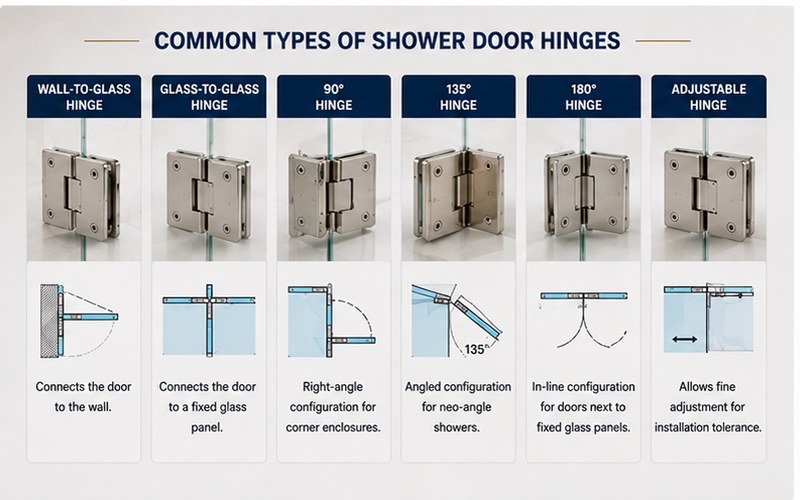
There are many types of shower door hinges, so buyers should evaluate the material together with the hinge configuration.
For pivot-style configurations, buyers can also review our glass shower door pivot hinges guide before confirming the hinge specification.
Wall-to-Glass Shower Door Hinges
These hinges connect the moving door directly to the wall.
The wall structure and fasteners are therefore critical.
Glass-to-Glass Shower Door Hinges
These connect the moving door to a fixed glass panel.
Buyers should consider the stability of that fixed panel together with the hinge.
90°, 135° and 180° Hinges
These configurations correspond to different glass layouts.
The geometry affects installation and glass processing, regardless of whether the hinge uses stainless steel or brass.
Adjustable Shower Door Hinges
These are useful when installers need limited installation correction.
Again, the adjustment mechanism matters more than whether the visible hinge body is stainless steel or brass.
Compare Total Project Cost, Not Unit Price
This is one of the most important B2B considerations.
A buyer may save a few dollars per hinge but lose much more through:
- Rejected finishes
- Replacement glass
- Installation delays
- Loose hardware
- Missing spare parts
- Customer complaints
- Rework
The cheapest hinge is not necessarily the lowest-cost option for the complete project.
When comparing quotations, consider:
Product price + installation efficiency + failure risk + replacement availability + maintenance
This is particularly important for hotels and apartment projects where the same hardware may be installed hundreds of times.
Ask Whether the Sample and Mass Production Use the Same Material
A B2B buyer should confirm that the approved sample represents the actual order.
Before production, record:
| Item | Buyer Should Confirm |
| Base Material | Stainless steel grade or brass specification |
| Hinge Dimensions | Match approved drawing |
| Glass Thickness | Compatible range |
| Surface Finish | Approved color/sample |
| Internal Components | Pivot, pins, screws, bushings |
| Gaskets | Material and thickness |
| Function | Opening and closing behavior |
| Adjustment | Mechanism and range |
| Packaging | Protection from scratches |
This makes quality inspection much easier when the bulk order is completed.
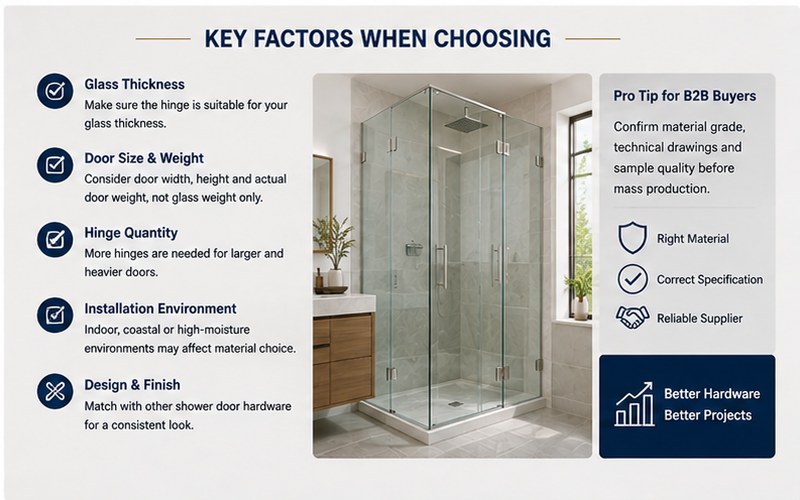
Which Material Should Different B2B Projects Choose?
Apartments
For standardized apartment projects, stainless steel shower door hinges, especially SS304 for appropriate indoor environments, can provide a practical balance of appearance, strength and procurement consistency.
Hotels
Both stainless steel and brass may work well.
The decision often depends on bathroom design, finish specification, maintenance strategy and purchasing budget.
Premium decorative interiors may favor certain brass designs, while modern hotel projects often standardize stainless steel hardware.
Coastal Projects
Higher corrosion exposure should be considered carefully.
SS316 may be appropriate depending on the environment and project specification.
Luxury Residential Projects
The architectural finish may become a bigger deciding factor.
In these situations, high-quality brass or stainless steel can both be suitable if the finish and hardware design match the overall interior concept.
AOYU HARDWARE Approach to B2B Shower Door Hardware
For B2B projects, material should be selected together with the complete door configuration rather than as an isolated specification.
AOYU HARDWARE provides shower hardware including shower door hinges, glass-to-glass hinges, wall-to-glass hinges, shower door handles, glass clamps, shower door support bars, shower sliding systems and related glass fittings.
For project inquiries, buyers can provide glass thickness, door dimensions, required finish, quantity and installation configuration so the hardware specification can be evaluated before mass production.
FAQ: Questions B2B Buyers Really Ask
1. Is stainless steel always better than brass for shower door hinges?
No. Stainless steel offers excellent structural and corrosion performance, while brass can provide reliable performance and attractive decorative finishes. The better choice depends on the project environment, hinge design, finish requirements and budget.
2. If two hinges look exactly the same, how can I tell whether one is stainless steel or brass?
Appearance alone is not reliable because both materials can receive similar finishes. Ask the supplier for the base-material specification and, for larger orders, request material documentation when necessary.
3. Should I pay more for SS316 shower door hinges?
Only when the project conditions justify it. SS316 may be useful in coastal or higher-chloride environments, while SS304 is commonly suitable for many standard indoor shower applications.
4. Can brass shower door hinges support heavy tempered glass doors?
They can when the hinge is properly engineered and rated for the door dimensions. Buyers should check actual tested or recommended load conditions rather than assuming capacity based only on the base material.
5. Can I use stainless steel hinges with brass-finish handles and glass clamps?
Yes, provided the visible finishes match the approved project standard. However, different base materials and coating processes can create color variations, so buyers should compare physical samples before mass production.
6. Which material is easier to maintain for a hotel project?
Both can be suitable when correctly specified. For hotel procurement, consistent surface treatment, replacement availability and cleaning procedures are often more important than choosing a material based on name alone.