



Pivot hinges for glass shower doors should be selected as part of the complete door system rather than as individual hardware pieces. B2B buyers need to match the hinge material, glass thickness, door height and width, pivot position, supporting structure and required opening function. Stainless steel is widely used for shower applications, but the hinge’s actual load capacity depends on much more than material alone. Door width, pivot location, top and bottom alignment and installation accuracy all influence performance. A glass shower door pivot hinge should also be installed according to an approved glass-processing drawing because incorrect holes or pivot positions can make tempered glass unusable. For hotel, apartment and commercial projects, using one standardized installation procedure can reduce door sagging, uneven gaps and repeated site adjustments.
What Makes a Pivot Hinge Different from a Standard Shower Door Hinge?
A conventional shower hinge commonly supports the door along one vertical side.
By contrast, a pivot hinge glass shower door system works differently.
The door rotates around a defined pivot axis, usually controlled by an upper and lower pivot point. Depending on the system, the hardware may connect to the floor, ceiling, header, wall or fixed glass.
As a result, this changes the way the load travels through the door.
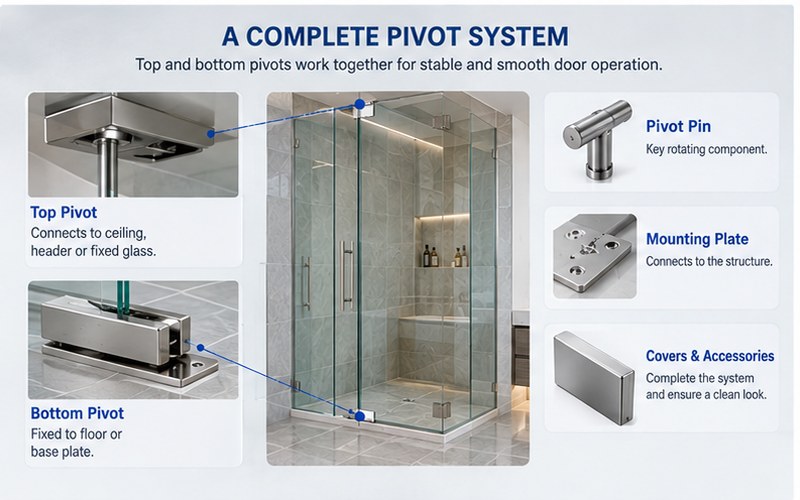
Instead of looking only at the hinge plate, B2B buyers need to consider:
- Top pivot
- Bottom pivot
- Pivot centerline
- Glass dimensions
- Supporting surface
- Opening arc
- Door clearance
A good pivot hinge for glass door applications is therefore part of an engineered door configuration rather than simply a decorative fitting.
Choosing the Right Material for Glass Shower Door Pivot Hinges
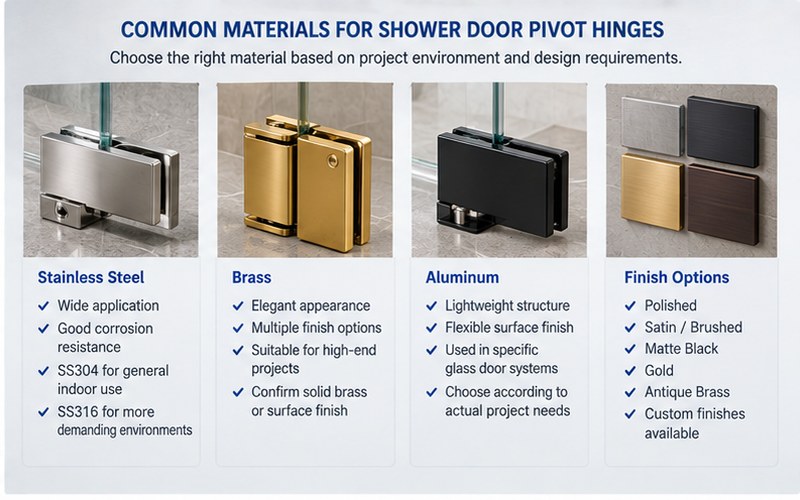
In general, material affects corrosion resistance, mechanical performance, appearance and long-term maintenance.
Stainless Steel Pivot Hinges
For example, stainless steel is one of the most common materials for architectural shower hardware.
In particular, SS304 is widely used for many indoor shower projects because it provides a practical balance of corrosion resistance, strength and appearance.
By comparison, SS316 may be considered for more demanding environments such as coastal locations or areas with higher chloride exposure. is higher.
However, B2B buyers should not only ask:
“Is this hinge stainless steel?”
Instead, they should ask which components use the specified grade.
For example:
- Main hinge body
- Pivot pin
- Mounting plate
- Screws
- Adjustment parts
- Decorative covers
However, a polished stainless steel cover does not automatically mean every load-bearing part uses the same material.
Brass Pivot Hinges
In addition, brass is used for selected glass shower door pivot hinges, especially when decorative finishes or particular design styles are required.
Therefore, buyers should distinguish between:
Solid brass hardware
and
brass-colored surface finishes
For example, a gold or antique brass appearance does not necessarily indicate a brass base material.
Aluminum and Other Materials
Certain glass-door systems may also use aluminum components because of their lighter weight and surface-finishing flexibility.
However, buyers should select materials based on the actual product engineering and project requirements rather than assuming one metal is universally superior.
Load Capacity: Why the KG Number Is Not Enough
In practice, load capacity is one of the most misunderstood specifications when sourcing pivot hinges for glass shower doors.
A quotation may say:
Maximum Load: XX kg
However, that number alone cannot tell you whether the hinge is suitable.
Door Width Changes Mechanical Demand
For example, consider two glass doors with the same weight.
One is narrow.
The other is significantly wider.
As a result, the wider door places its center of mass farther from the pivot axis, creating greater leverage.
Therefore, buyers should provide:
- Glass thickness
- Door height
- Door width
- Approximate weight
- Pivot position
- Hardware configuration
As a result, this gives the supplier a much better basis for evaluating load capacity.
For detailed weight calculations by glass thickness and door size, see our pivot hinge weight and thickness guide.
Pivot Position Also Matters
A pivot located very close to the edge of the glass creates a different opening geometry from one positioned further inward.
For example, the pivot location can influence:
- Door balance
- Opening arc
- Required clearance
- Mechanical loading
- Handle movement
For this reason, do not change the pivot centerline after approving the hinge without rechecking the complete door design.
What Should B2B Buyers Ask About Load Capacity?
Instead of asking only:
“How many kilograms can this hinge carry?”
ask:
- What is the recommended maximum door width?
- What is the maximum recommended door height?
- What glass thickness was used for testing?
- Is the stated load based on the complete top-and-bottom pivot system?
- Does the pivot position affect the recommended load?
- Does adjustment reduce the approved capacity?
Therefore, these questions give buyers much more useful engineering information.
Glass Thickness and Glass Preparation
Common tempered glass used in shower doors may include:
- 8mm
- 10mm
- 12mm
However, buyers should always follow the range specified for the actual glass shower door pivot hinge.
Why Glass Thickness Matters
The hardware may use:
- Gaskets
- Clamping plates
- Sleeves
- Pivot fittings
- Glass cut-outs
that are designed around a specific thickness range.
As a result, incorrect glass thickness can affect clamping, alignment and installation stability.
Approve Glass Cut-Outs Before Tempering
Before ordering tempered glass, confirm:
- Hole diameter
- Hole center
- Notch dimensions
- Glass edge distance
- Pivot centerline
- Top fitting position
- Bottom fitting position
In general, tempered glass cannot be drilled or cut again after production.
As a result, one incorrect dimension can turn a usable door into a replacement panel.
Installation Guide for Pivot Hinges on Glass Shower Doors
In addition, correct installation is just as important as correct hardware selection.
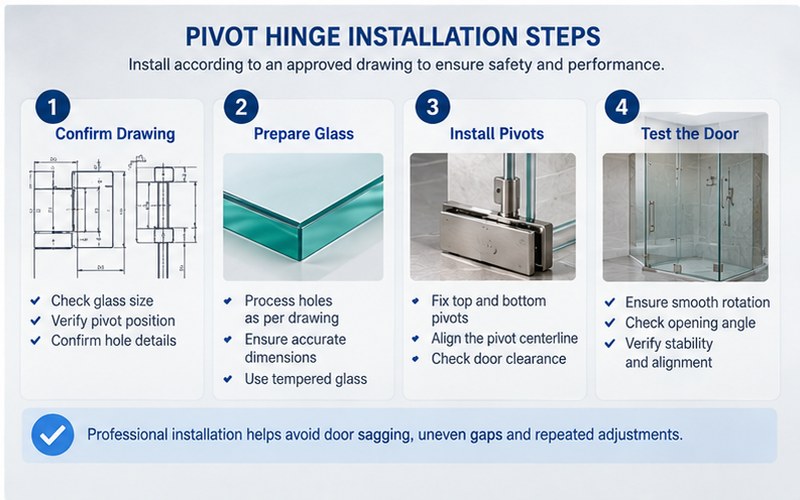
Step 1: Check All Components Before Installation
Before bringing the glass into position, confirm that the installation set includes the correct:
- Top pivot
- Bottom pivot
- Screws
- Gaskets
- Bushings
- Mounting plates
- Decorative covers
Next, compare the parts with the approved drawing.
Step 2: Verify the Supporting Structure
In addition, the supporting surface must be strong enough to carry the system.
For example, depending on the design, this may include:
- Floor
- Ceiling
- Header
- Wall
- Fixed glass
A strong pivot hinge for glass door systems cannot compensate for an inadequate supporting structure.
Step 3: Confirm the Bottom Pivot Position
First, the bottom pivot establishes one of the key reference points.
Position it according to the approved centerline.
Therefore, a small position error at this stage can later affect the entire door alignment.
Step 4: Align the Top Pivot Vertically
Next, the upper and lower pivot centers must align correctly.
Poor vertical alignment may cause:
- Door binding
- Uneven movement
- Inconsistent glass gaps
- Increased wear
- Difficult closing
For this reason, installers should use appropriate measuring and leveling tools rather than relying only on visual alignment.
Step 5: Install the Glass with Correct Gaskets
In addition, glass should never contact metal directly where the hinge design requires protective gaskets.
Check that:
- The correct gasket thickness is used
- Gaskets sit flat
- No debris remains between glass and hardware
- Clamping pressure is even
Overtightening can create unnecessary stress, while insufficient tightening may allow movement.
Step 6: Check Door Clearance Before Final Tightening
Before fully locking the hardware in position, test the opening arc.
Pay attention to:
- Adjacent fixed glass
- Wall clearance
- Floor clearance
- Shower door handles
- Seals
- Thresholds
However, a door may appear correctly installed when closed but interfere with another component when opened.
Step 7: Test the Complete Opening and Closing Cycle
Finally, after installation, open and close the door several times.
Check:
- Smooth rotation
- Consistent gaps
- Stable closing position
- No glass-to-metal contact
- No unusual movement
- Secure fasteners
If the hinge is adjustable, make only small corrections according to the hardware design.
How Adjustable Pivot Hinges Should Be Handled
For example, some glass shower door pivot hinges provide limited adjustment.
For projects that require more alignment flexibility, buyers can also compare adjustable glass shower door hinges before selecting a final model.
Possible adjustment functions may include:
- Closing-position correction
- Alignment
- Pivot-angle adjustment
- Limited door centering
However, adjustment should not be used to hide major installation errors.
If the door is significantly out of position, check:
- Pivot centerline
- Glass cut-out
- Wall alignment
- Floor level
- Top-to-bottom pivot alignment
before repeatedly adjusting the hinge.
Common Installation Problems B2B Buyers Should Prevent
Door Sagging
Possible causes include:
- Incorrect load specification
- Loose hardware
- Incorrect gasket installation
- Excessive door width
- Poor supporting structure
Uneven Glass Gaps
First, check the pivot alignment and surrounding fixed panels.
In fact, the problem may come from the entire enclosure geometry rather than the hinge itself.
Door Rubbing Against a Seal
Shower door seals need sufficient clearance.
Therefore, the seal profile should be considered before finalizing glass dimensions.
Handle Interference
Large shower door handles can extend into the opening path.
Handle position should therefore be checked together with the door swing.
Coordinate the Pivot Hinge with Other Shower Door Hardware
In practice, a pivot door rarely works alone.
The surrounding system may include:
Glass Clamps for Shower Doors
Glass clamps for shower doors secure fixed glass panels and may influence overall enclosure stability.
Shower Door Support Bars
For larger fixed panels, shower door support bars provide additional stability.
Shower Door Handles
Handle position should match the door’s opening arc and user access.
Shower Door Seals
Seals affect the final gap and closing resistance.
U-Channels
U-channels can provide continuous support for selected fixed glass panels.
These product terms are natural internal-link opportunities within the article.
Create a Standard Installation Procedure for Large Projects
For hotel or apartment developments, different installers should not use different installation methods for the same hinge.
A simple project installation standard can specify:
| Installation Item | Standard to Confirm |
| Pivot Centerline | Approved drawing |
| Glass Thickness | Correct specified range |
| Top/Bottom Alignment | Vertically aligned |
| Gaskets | Correct type and position |
| Fasteners | Correct sequence and security |
| Door Gap | Project-approved clearance |
| Opening Angle | Matches design |
| Handle Clearance | No interference |
| Seal Contact | Correct and consistent |
| Final Inspection | Smooth operation |
As a result, this reduces variations between rooms and simplifies troubleshooting.
AOYU HARDWARE Support for B2B Pivot Door Projects
AOYU HARDWARE supplies shower and architectural glass hardware including glass shower door pivot hinges, shower door hinges, glass-to-glass hinges, wall-to-glass hinges, shower door handles, glass clamps and shower door support bars.
For B2B project inquiries, buyers should provide the door dimensions, glass thickness, opening direction, installation layout and required finish before final hardware selection.
Technical confirmation before glass processing is one of the most effective ways to reduce installation errors and replacement costs.
FAQ: Questions B2B Buyers Really Ask About Pivot Hinges
1. Can I use a heavier glass door if I install a stronger bottom pivot?
Not necessarily. In fact, the top and bottom components work as a complete system. Door width, height, weight, pivot position and supporting structure should all be checked before changing only one component.
2. Why does the supplier need my glass door width when I already provided the weight?
For example, door width changes the leverage applied around the pivot axis. Two doors with identical weight but different widths can place different mechanical demands on the hardware.
3. Can installers adjust a pivot door if the top and bottom pivots are not perfectly aligned?
However, limited adjustment may help with minor tolerances on certain hinges, but it should not replace correct pivot alignment. As a result, significant misalignment can cause binding and premature wear.
4. Can I install the pivot hinge after the tempered glass has already been manufactured?
However, this is only possible if the existing glass holes and cut-outs match the exact hardware drawing. If they do not match, modifying tempered glass may not be possible.
5. How do I know whether SS304 or SS316 is better for my project?
SS304 is commonly used for many indoor shower applications.By comparison, SS316 may be considered for more demanding environments such as coastal locations or areas with higher chloride exposure. Project conditions should determine the choice.
6. Should we install a complete sample door before ordering hundreds of pivot hinges?
For large projects, yes. Therefore, a complete mock-up can verify the glass preparation, pivot alignment, opening arc, handle clearance, seals and installation procedure before mass production begins.