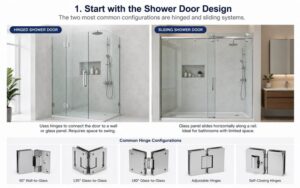



Choosing the right glass shower door pivot hinge starts with the door geometry, not the hinge appearance. Therefore, B2B buyers should confirm the glass thickness, door height and width, approximate weight, top and bottom pivot positions, opening direction, required clearance and surrounding fixed-glass layout before approving a model. For this reason, a pivot hinge for glass door installations carries and rotates the door around a defined pivot axis, and incorrect pivot positioning can affect door movement even when the hinge itself is strong enough. In addition, buyers should verify the glass cut-outs, mounting structure, opening angle and whether the selected hardware is fixed, adjustable, self-centering or free-swing. Finally, for hotels, apartments and commercial shower projects, technical drawings and a complete mock-up should be approved before mass glass production.
What Is a Glass Shower Door Pivot Hinge?
Unlike a conventional side-mounted hinge, a glass shower door pivot hinge allows the door to rotate around a defined pivot point.
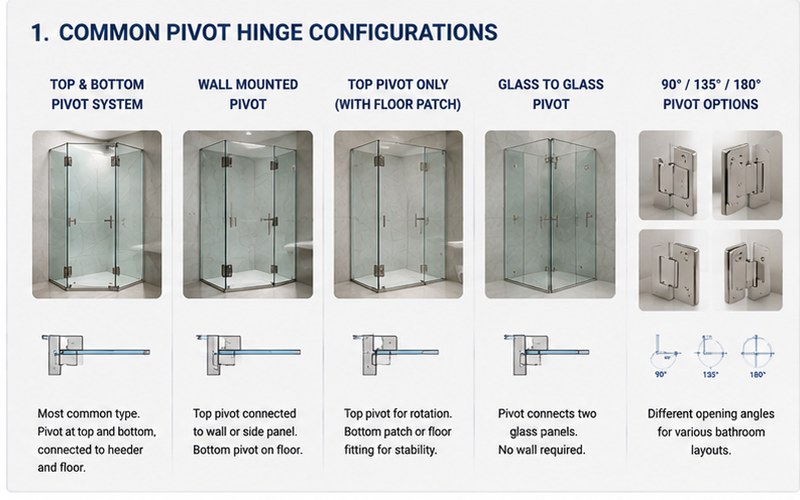
The pivot axis is usually positioned near the top and bottom of the door. Depending on the hardware design, the pivot may connect the moving glass to:
- A header
- A floor or threshold
- A wall-mounted fitting
- A fixed glass panel
- A matching top and bottom pivot system
This creates a different load path from many traditional wall-to-glass hinges.
As a result, this difference matters for B2B buyers because the supporting structure, pivot location and door dimensions all influence system performance.
Pivot System vs Conventional Hinged System
In practice, a common sourcing mistake is treating a pivot hinge glass shower door system as just another decorative hinge style.
However, the mechanics are different.
Conventional Side-Mounted Hinges
By comparison, traditional shower hinges commonly attach along the vertical edge of the door.
They may be:
The door load acts through hinges positioned along one vertical edge.
How the Pivot System Works
In contrast, with pivot hinges for glass shower doors, the door rotates around top and bottom pivot points.
This can create a clean architectural appearance and may allow different door layouts, but buyers must pay more attention to:
- Pivot-axis position
- Top and bottom alignment
- Floor or header support
- Door clearance
- Glass processing
Neither system is automatically better. The correct choice depends on the enclosure design.
For projects with limited swing clearance, buyers may also compare glass sliding shower door hardware as an alternative system.
Start With the Glass Door Dimensions
Before asking a supplier for a quotation, prepare the basic glass information.
Glass Thickness
Common shower-door glass may include:
- 8mm tempered glass
- 10mm tempered glass
- 12mm tempered glass
However, buyers should use only the thickness range specified for the actual hinge model.
A pivot fitting designed around one glass range may use different gaskets, clamping dimensions or glass cut-outs from another model.
Door Height and Width
In addition, height and width matter as much as thickness.
A wider glass door creates more leverage around the pivot axis. Therefore, two doors with the same weight may not place the same mechanical demand on the hardware.
When requesting a pivot hinge for glass door applications, send:
Glass Thickness + Door Height + Door Width + Approximate Weight
This gives the supplier far more useful information than door weight alone.
Check the Rotation Point Carefully
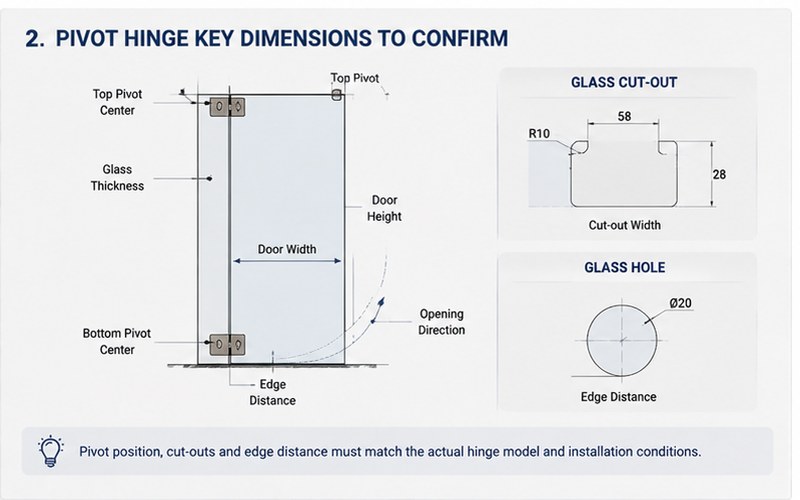
Pivot position is one of the most important specifications in a pivot door.
Why Axis Position Matters
For example, the distance between the pivot axis and the edge of the glass affects how the door moves through its opening arc.
If the axis is positioned farther inward, part of the glass may swing in a different path from a conventional edge-mounted hinge.
That means the buyer must consider:
- Nearby fixed glass
- Wall clearance
- Handle clearance
- Shower seals
- Threshold position
- Internal bathroom space
As a result, a pivot hinge that physically fits the glass may still create interference if the opening path was not checked.
Ask for an Opening Diagram
For project orders, request a drawing showing:
- Pivot centerline
- Door edge
- Opening direction
- Maximum opening angle
- Required side clearance
For this reason, an opening diagram is particularly valuable before the architect or glass processor finalizes dimensions.
Upper and Lower Alignment Must Match
A glass shower door pivot hinge system depends on accurate alignment between the upper and lower pivot points.
If these points are not vertically aligned, the door may:
- Bind during movement
- Close unevenly
- Create inconsistent gaps
- Place unnecessary stress on the hardware
- Become difficult to install
For this reason, B2B projects should not treat the top pivot and bottom pivot as two unrelated components.
Together, they must work as one coordinated pivot system.
What Buyers Should Confirm
Ask the supplier for:
- Top pivot dimensions
- Bottom pivot dimensions
- Centerline position
- Required installation tolerance
- Matching glass preparation
- Recommended installation sequence
In addition, for larger projects, these dimensions should be included in the approved technical drawing.
For a more detailed pre-order review, buyers can also read our glass shower door pivot hinge ordering checklist.
Load Capacity Needs More Than a Weight Rating
Buyers often ask:
“How many kilograms can this glass shower door pivot hinge hold?”
However, that information alone is incomplete.
Actual suitability depends on:
- Door height
- Door width
- Glass thickness
- Pivot position
- Hardware structure
- Supporting surface
- Installation accuracy
A published maximum load should therefore be treated as one selection factor, not the complete specification.
Wider Doors Need Special Attention
As the door becomes wider, the distance between the pivot and the outer edge increases.
As a result, this can increase leverage on the system.
Therefore, a hinge rated for a certain weight under one door size should not automatically be assumed suitable for every door of the same weight.
For B2B orders, always ask for the recommended maximum door dimensions as well as the load rating.
Confirm the Opening Function
Different glass shower door pivot hinges can behave differently.
Depending on the specific model, a pivot hinge may offer:
- Single-direction opening
- Two-way opening
- Fixed resting position
- Self-centering function
- Limited adjustment
- Hold-open function
Therefore, buyers should never assume these features from appearance alone.
Buyers who need additional alignment flexibility can also compare adjustable glass shower door hinges before selecting a final configuration.
Ask Before Ordering
For every model, confirm:
- Which direction can the door open?
- What is the maximum opening angle?
- Does the door return to center?
- Is there a hold-open position?
- Can the resting angle be adjusted?
- Does adjustment affect the recommended load?
In particular, this information is important for hotels and apartment developments where every door should behave consistently.
Glass Cut-Outs Must Be Approved Before Tempering
This is one of the highest-cost mistakes in glass hardware sourcing.
Once glass has been tempered, holes and cut-outs generally cannot simply be changed.
For example, a pivot system may require specific:
- Holes
- Notches
- Edge distances
- Pivot-center positions
- Cut-out dimensions
Therefore, before releasing glass production, buyers should obtain the final hardware drawing.
Two pivot hinges for glass shower doors can look nearly identical but require different glass preparation.
If the wrong cut-out is processed across 100 doors, the cost of the glass replacement can be far greater than the value of the hinges themselves.
Consider Door Clearance and Shower Seals Together
A pivot door requires enough clearance to rotate freely.
This means the hinge selection should be coordinated with shower door seals.
The final gap must accommodate both:
- Glass movement
- Seal thickness
If the gap is too narrow, the seal may create excessive resistance.
If it is too wide, water control may become less effective.
For a professional B2B project, the glass drawing, pivot axis and seal profile should therefore be reviewed together.
Coordinate the Fixed Panels Around the Door
In addition, a pivot door often works beside one or more fixed glass panels.
In addition, these panels may use related shower door hardware, including:
Glass Clamps for Shower Doors
Glass clamps can secure smaller fixed panels to walls or adjacent structures.
Shower Door Support Bars
Larger panels may require shower door support bars to improve stability.
In particular, this becomes important when the fixed glass forms part of the supporting structure around the pivot door.
U-Channels
Glass U-channels can provide continuous support along an edge and may be useful in selected frameless enclosure designs.
Shower Door Handles
Shower door handles should also be positioned with the pivot opening arc in mind.
For example, a long handle placed too close to an adjacent panel can create interference even when the door glass itself has enough clearance.
For a broader overview of hinges, handles, clamps, seals and other components, read our complete shower door hardware guide.
Stainless Steel Options for Shower Projects
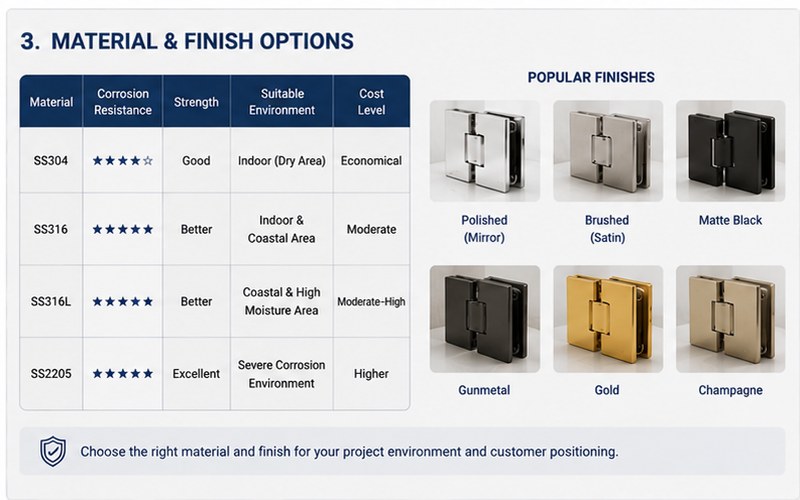
Many project buyers prefer stainless steel for architectural shower hardware.
A stainless steel pivot hinge can coordinate well with other fittings such as stainless steel handles, clamps and support bars.
For indoor shower applications, SS304 is commonly specified.
For more corrosive environments, buyers may evaluate SS316 according to the project conditions.
However, the visible plate is not the only component that matters.
Ask what materials are used for:
- Pivot pins
- Screws
- Internal bushings
- Adjustment components
- Clamping plates
As a result, buyers get a more complete picture of product quality.
Use a B2B Hardware Selection Checklist
Before approving a glass shower door pivot hinge, confirm:
| Selection Item | Buyer Should Check |
| Glass Thickness | Compatible range |
| Door Height | Within recommended limit |
| Door Width | Within recommended limit |
| Door Weight | Within tested/recommended load |
| Pivot Position | Correct centerline |
| Top Pivot | Matches lower pivot |
| Bottom Pivot | Correct mounting structure |
| Opening Direction | Single or double action |
| Opening Angle | Meets project layout |
| Adjustment | Fixed or adjustable |
| Glass Processing | Approved holes and cut-outs |
| Clearance | Door, wall, glass and handles |
| Seals | Compatible closing gap |
| Finish | Matches other shower hardware |
Therefore, this checklist is especially useful when comparing several suppliers.
For broader project selection criteria, buyers can also review our guide on how to choose shower door hardware.
Why B2B Buyers Should Build One Complete Sample Door
For a single retail order, buyers may purchase the hinge and make adjustments during installation.
For a large project, that approach is risky.
Before mass production, build one complete shower-door sample using:
- Final glass thickness
- Final glass cut-outs
- Pivot hardware
- Handle
- Seals
- Fixed-panel hardware
- Support bar if required
Then test:
- Opening movement
- Door gap
- Closing position
- Pivot alignment
- Handle clearance
- Seal contact
- Installation sequence
Ultimately, a small mock-up cost can prevent a much larger project error.
AOYU HARDWARE supplies glass shower hardware for B2B applications, including glass shower door pivot hinges, shower door hinges, glass-to-glass hinges, wall-to-glass hinges, shower door handles, glass clamps, shower door support bars and related glass fittings.
For project inquiries, providing glass dimensions, door drawings, required finishes and installation layouts helps confirm the appropriate hardware before glass processing and mass production.
FAQ: Questions B2B Buyers Really Ask About Glass Shower Door Pivot Hinges
1. Can I choose the hardware based only on door weight?
No. In addition to door weight, door width, height, glass thickness, pivot position and supporting structure also affect performance. Therefore, send the supplier the complete door dimensions when confirming load capacity.
2. Are both upper and lower fittings required?
Most pivot systems rely on coordinated upper and lower pivot points, although the exact construction depends on the hardware design. For this reason, always use the components specified as a compatible system rather than mixing unrelated fittings.
3. Can the rotation point be changed after tempering?
Usually not, because changing the pivot position may require different holes or cut-outs. Therefore, compare the hardware drawing with the existing glass before ordering replacement pivot hardware.
4. How much opening clearance is required?
There is no universal clearance because it depends on the pivot position, glass dimensions, opening angle and seal profile.For this reason, request an opening diagram from the supplier and check the complete door swing before processing the glass.
5. Can the hardware be adjusted after installation?
Some models provide limited adjustment, while others use fixed pivot geometry. Buyers should ask what can be adjusted, the available range and whether adjustment can be performed with the door installed.
6. What information should I send for a quotation?
First, provide the glass thickness, door height, width, approximate weight, quantity, pivot position, opening direction, required finish and installation drawing. In addition, for unusual layouts, sending a sketch or project drawing helps reduce specification errors.