


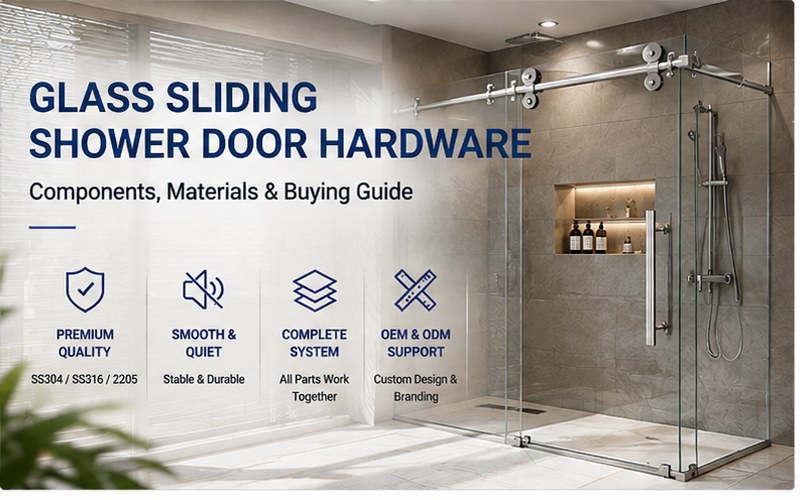
Glass sliding shower door hardware plays an important role in the performance and reliability of modern shower enclosures. Choosing the right system is not only about appearance. Instead, a reliable sliding shower enclosure depends on the correct combination of rails, rollers, guides, stoppers, connectors, handles, seals, glass thickness, and installation dimensions.
For B2B buyers, including shower enclosure manufacturers, glass processors, distributors, contractors, and project buyers, even a small hardware selection mistake can create much bigger installation problems. For example, a roller may not match the rail, a bottom guide may not fit the glass, or an incorrect drilling position may require a new tempered glass panel. In addition, low-grade stainless steel may develop corrosion or discoloration much earlier than expected.
For this reason, professional buyers should treat glass sliding shower door hardware as a complete system rather than a collection of separate fittings. This guide explains the main components, material choices, common purchasing problems, and technical points B2B buyers should confirm before placing an order.
For example, a roller may not match the rail, while the bottom guide may not fit the glass. In addition, an incorrect drilling position may require a new tempered glass panel. Low-grade stainless steel may also develop corrosion or discoloration much earlier than expected.
For this reason, professional buyers should treat glass sliding shower door hardware as a complete system rather than a collection of separate fittings.
This guide explains the main components, material choices, common purchasing problems, and technical points B2B buyers should confirm before placing an order.
What Is Glass Sliding Shower Door Hardware?
Glass sliding shower door hardware is the complete system of fittings used to support, guide, stop, and operate a sliding glass shower door.
Unlike a hinged door, the moving glass panel travels horizontally along a rail or track.
As a result, this makes sliding systems suitable for apartments, hotels, villas, residential bathrooms, and other applications where saving opening space is important.
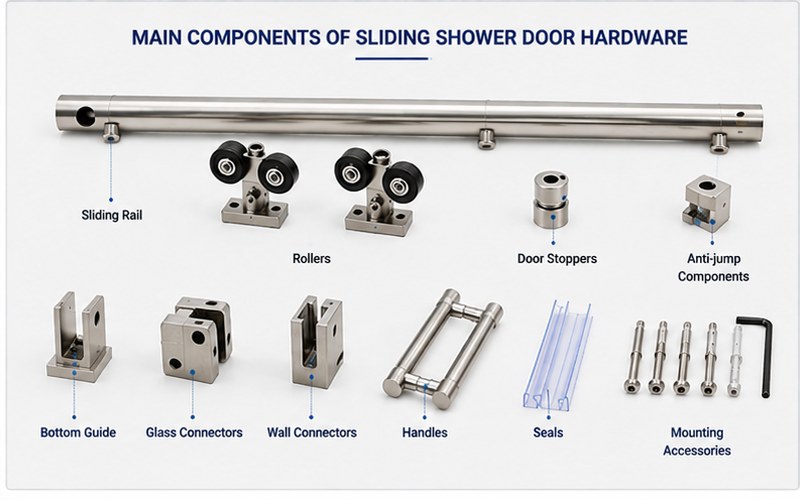
A typical system includes several sliding shower door parts, and each part has a different function.
For example, the system normally includes:
- Sliding rail
- Rollers
- Door stoppers
- Bottom guide
- Anti-jump components
- Glass connectors
- Wall connectors
- Handles
- Seals
- Mounting accessories
The performance of the finished door depends on how well these components work together.
Buyers comparing different system designs can also read our complete guide to sliding shower door systems.
Main Components of a Sliding Shower Door System
Sliding Rail
First, the rail provides the main path for the moving glass panel.
Common designs include round rails and square-profile rails.
Buyers should select the rail according to the door dimensions, roller design, installation method, and required appearance.
A rail that does not match the roller correctly may cause noise, friction, or unstable movement.
Shower Door Rollers
Rollers are among the most important sliding shower door parts because they carry the moving glass panel.
When selecting rollers, buyers should confirm:
- Roller diameter
- Rail compatibility
- Glass thickness
- Door weight
- Bearing quality
- Adjustment method
- Drilling dimensions
A roller may look attractive in a product photo, but what matters more is whether it can provide smooth and stable movement under the actual weight of the glass.
Door Stoppers
In addition, door stoppers define the opening and closing limits of the moving panel.
Incorrect stopper positions can reduce the usable opening or allow the door to move too far.
For a professional shower door hardware kit, buyers should consider stopper positions during the design stage.
Bottom Guide
The bottom guide keeps the lower edge of the glass aligned during operation.
Although it is a small fitting, it plays an important role in the stability of sliding shower door hardware.
The guide should match the glass thickness and the spacing between fixed and moving panels.
Glass Connectors and Handles
Similarly, glass connectors help connect fixed glass panels, rails, walls, or supporting structures.
Handles allow users to operate the sliding door and should match the drilling dimensions prepared in the glass.
All visible components should also use coordinated finishes for a consistent final appearance.
B2B buyers can also explore our sliding shower door hardware range for complete system options and project applications.
Common Compatibility Problems in Sliding Shower Systems
One of the most common purchasing problems is selecting sliding shower door parts only by appearance.
Two rollers can look nearly identical but use different rail diameters.
Two bottom guides can look the same but have different internal widths.
A connector may fit one system but not another.
This is why buyers should avoid mixing unrelated components unless buyers have confirmed technical compatibility.
For distributors and shower enclosure manufacturers, standardizing one tested system is usually more efficient than purchasing every component separately.
A coordinated shower door hardware kit can reduce installation errors, simplify inventory, and make replacement parts easier to manage.
Buyer Pain Point: Wrong Glass Drilling Cannot Be Easily Corrected
Glass preparation is one of the most critical stages of a sliding shower project.
Importantly, tempered glass normally cannot be drilled after tempering.
Therefore, the roller holes, handle holes, and connector positions must be confirmed before glass processing.
Information Buyers Should Confirm
Before ordering glass sliding shower door hardware, provide:
- Glass thickness
- Door width
- Door height
- Fixed panel dimensions
- Opening width
- Rail length
- Roller hole positions
- Handle hole spacing
- Connector positions
- Required finish
For custom projects, buyers should approve technical drawings before glass production.
A small drilling mistake can cost much more than the hardware itself.
Materials for Glass Sliding Shower Door Hardware
The bathroom is a wet and humid environment.
For this reason, material selection should be treated as a major purchasing specification rather than a minor detail.
For quality-focused stainless steel glass sliding shower door hardware, AOYU HARDWARE recommends using SS304 as the practical starting specification.
SS304: The Recommended Choice for Most Indoor Bathrooms
SS304 offers a good balance of strength, corrosion resistance, appearance, durability, and cost.
It is widely suitable for:
- Sliding rails
- Handles
- Glass connectors
- Support components
- Rollers
- Mounting fittings
For normal indoor shower applications, SS304 is usually a reliable choice.
In addition, distributors and project buyers can reduce problems such as early discoloration, corrosion, customer complaints, and replacement costs by choosing SS304.
Why Buyers Should Be Careful with SS201
SS201 is generally cheaper than SS304, but its corrosion resistance is lower.
In a humid bathroom environment, especially where cleaning chemicals are frequently used, SS201 may be more likely to develop discoloration or surface corrosion over time.
SS201 is generally cheaper than SS304, but its corrosion resistance is lower. However, in a humid bathroom environment, especially where cleaning chemicals are frequently used, SS201 may be more likely to develop discoloration or surface corrosion over time.
Although SS201 may still suit very price-sensitive applications, professional buyers should understand the trade-off. Therefore, SS304 is generally a safer specification when long-term durability and fewer after-sales problems are the priority.
SS316: Better for Coastal and High-Humidity Projects
For coastal regions or projects located near the sea, SS316 is a better choice when the budget allows.
Salt and chloride exposure can accelerate corrosion, especially in beachfront hotels, seaside villas, resorts, and other coastal applications.
SS316 provides better resistance to chloride-related corrosion than SS304.
Where SS316 Is Recommended
SS316 is worth considering for:
- Coastal apartments
- Beachfront hotels
- Seaside villas
- Resorts
- Swimming pool areas
- High-humidity commercial projects
- Premium bathroom installations
Therefore, using a higher-grade material can improve long-term reliability in these environments.
For a detailed comparison, read our guide to SS304 vs SS316 shower hardware.
Duplex Stainless Steel 2205: A Premium Upgrade
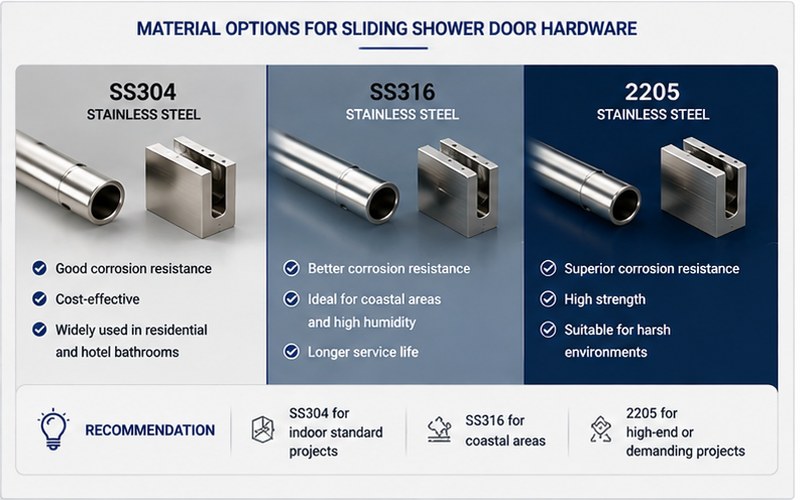
Therefore, a simple purchasing principle is: SS304 for normal quality projects, SS316 for coastal environments, and 2205 for premium or highly demanding applications.
Where 2205 Can Make Sense
2205 may be suitable for:
- Luxury coastal projects
- Premium resorts
- High-corrosion environments
- Long-life architectural projects
- Applications requiring higher mechanical strength
- Premium custom shower hardware
However, not every component needs to use 2205.
For most indoor bathrooms, SS304 is sufficient. However, SS316 is usually the better upgrade for coastal applications. Meanwhile, 2205 can provide a premium option for highly demanding environments where suitable.
A simple purchasing principle is:
SS304 for normal quality projects, SS316 for coastal environments, and 2205 for premium or highly demanding applications.
Buyers comparing stainless steel with lower-cost alternatives can also read our SS304 vs zinc alloy shower hardware guide.
Buyer Pain Point: Material Grade Is Difficult to See from Photos
One challenge for international buyers is that SS201, SS304, and SS316 can look very similar when they are new.
A polished rail made from lower-grade stainless steel may appear almost identical in a product photo.
The difference may only become visible after long exposure to humidity, cleaning chemicals, or coastal air.
For this reason, buyers should ask the shower door hardware manufacturer to clearly state the stainless steel grade in the quotation, product specification, or purchase order.
For large projects, buyers can also request material verification when necessary.
Buyer Pain Point: Cheap Rollers Can Create Noise and Poor Movement
Customers expect a sliding shower door to move smoothly and quietly.
As a result, poor-quality rollers may become noisy loose, or uneven after repeated use.
The roller is not the only factor.
In fact, movement quality depends on:
- Roller machining
- Bearing quality
- Rail accuracy
- Door weight
- Alignment
- Bottom guide position
- Stopper setup
For hotel and commercial projects, this becomes especially important because the shower door may be operated many times each day.
Surface Finish Consistency Matters
A complete shower door hardware kit may contain rails, rollers, handles, connectors, clamps, and guides manufactured through different processes.
Even when every item is called “matte black” or “brushed gold,” the actual color may vary.
Common finishes include:
- Polished stainless steel
- Satin stainless steel
- Chrome
- Matte black
- Brushed gold
- Gunmetal
- Bronze
For bulk projects, buyers should approve finish samples before production whenever possible. whenever possible.
As a result, this helps reduce color differences across visible components.
What Is Included in a Sliding Shower Door Hardware Kit?
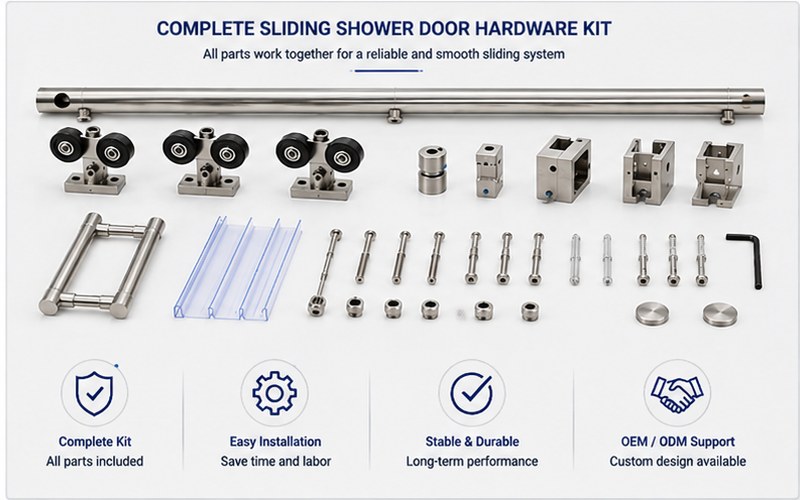
A typical sliding shower door hardware kit may include:
- Rail
- Rollers
- Door stoppers
- Bottom guide
- Anti-jump parts
- Glass connectors
- Wall connectors
- Handle
- Seals
- Screws
- Gaskets
- Mounting accessories
Small accessories should not be overlooked.
Missing screws, washers, or gaskets can prevent an installer from completing the project.
For B2B buyers, a clear parts list and standardized packaging can reduce warehouse and installation mistakes.
For a broader overview of hinges, handles, seals, and other components, read our complete shower door hardware guide.
What to Ask a Shower Hardware Manufacturer
When selecting a shower door hardware manufacturer, buyers should ask more than just the price.
In addition, B2B buyers should understand how to choose reliable shower door hardware based on material quality, system compatibility, and project requirements.
For B2B sourcing, buyers can also learn how to evaluate a reliable shower door hardware manufacturer before placing bulk or repeat orders.
Important questions include:
Can You Supply the Complete System?
The supplier should understand how the rail, rollers, guides, stoppers, connectors, and glass work together.
Can You Provide Technical Drawings?
This is especially important for glass drilling and custom systems.
Which Stainless Steel Grade Is Used?
Ask whether the product is SS304, SS316, 2205, or another material.
What Glass Thickness and Door Weight Are Supported?
Buyers should confirm these specifications before ordering.
Are Replacement Parts Available?
For distributors, replacement-part availability is important for long-term after-sales support.
AOYU HARDWARE Sliding Shower Door Solutions
AOYU HARDWARE supplies architectural glass hardware for international B2B customers, including shower enclosure manufacturers, glass processors, distributors, wholesalers, contractors, and project buyers.
The product range includes glass sliding shower door hardware, rails, rollers, handles, guides, stoppers, connectors, seals, and related sliding shower door parts.
Buyers can explore our complete shower door hardware range for sliding systems, hinges, handles, clamps, seals, support bars, and related components.
For customers requiring a complete shower door hardware kit, components can be coordinated according to glass thickness, door dimensions, installation layout, material, finish, and project requirements.
For stainless steel components, AOYU HARDWARE can match material selection to the application:
- SS304 for standard quality indoor projects
- SS316 for coastal or higher-corrosion environments
- 2205 for selected premium and demanding applications
OEM and ODM services are also available for customized finishes, branding, packaging, dimensions, and selected product configurations.
Frequently Asked Questions
What Is a Sliding Shower Door System?
It is a complete system of rails, rollers, guides, stoppers, connectors, handles, seals, and mounting components used to operate a sliding glass shower door.
Which Components Are Most Important?
The rail, rollers, bottom guide, stoppers, and connectors are particularly important because they directly affect movement and stability.
Which stainless steel grade is best?
For most quality indoor applications, SS304 is a strong starting choice. However, SS316 is preferred for coastal areas because of its higher corrosion resistance. For premium and more demanding projects, buyers can consider Duplex Stainless Steel 2205 for suitable components.
Why are technical drawings important?
Sliding systems often require accurate glass drilling and component positions. Drawings should be confirmed before glass tempering.
Should I Buy a Complete Hardware Kit?
For repeat projects and B2B distribution, a coordinated kit can improve compatibility, finish consistency, installation preparation, and replacement-part management.
Conclusion
The quality of glass sliding shower door hardware depends on much more than the appearance of the roller or rail.
Rails, rollers, guides, stoppers, connectors, handles, seals, glass dimensions, and drilling positions must all work together as one system.
Material selection is equally important.
In addition to component compatibility, material selection is equally important. For quality indoor projects, SS304 provides a practical starting point. However, for coastal or chloride-rich environments, SS316 offers better corrosion resistance. For more demanding premium projects, buyers can consider Duplex Stainless Steel 2205 for suitable components that require higher corrosion resistance and mechanical performance.
Overall, B2B buyers can reduce corrosion, installation errors, replacement costs, and long-term customer complaints by choosing the correct material and a compatible system during the purchasing stage.