


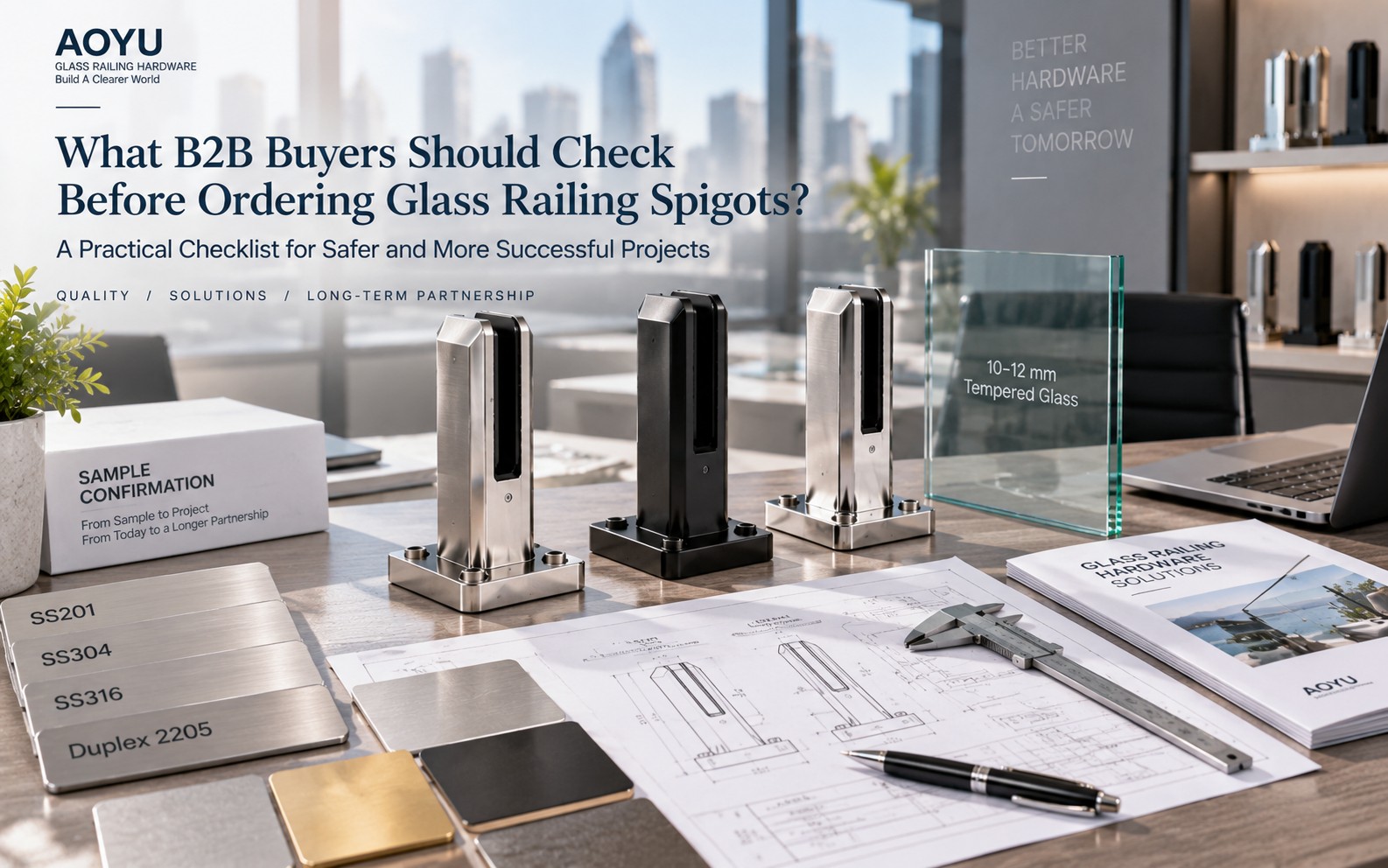
Before ordering a glass railing spigot, B2B buyers should confirm the glass thickness and panel size, installation environment, stainless steel grade, surface finish, spigot height, fixing base, and whether the supplier can keep the same specification for repeat orders. For many residential projects, 10–12 mm tempered glass is a common choice. As a practical reference for standard home applications, keeping a single panel around 1 m high and 1 m wide can provide a manageable and stable setup when the spigot system, anchors, substrate, and local railing requirements are suitable. Indoor, outdoor, and coastal projects also need different material choices. A clear pre-order checklist reduces wrong specifications, site rework, inconsistent finishes, and costly replacement problems.
1. Confirm the Glass Before Choosing a Glass Railing Spigot
The first step is confirming the glass, not choosing a finish or comparing prices.
For many residential frameless railing projects, 10–12 mm tempered glass is common. However, the correct thickness depends on the project design, panel dimensions, local requirements, and the specific glass railing spigot.For a broader overview of material, glass thickness, load capacity, and installation options, see our guide on how to choose a glass spigot for frameless glass railings.
Give the Supplier the Full Panel Size
Send the supplier the glass thickness, panel height, panel width, approximate panel weight, number of panels, planned number of spigots per panel, and installation location.
For common home projects, a panel around 1 m × 1 m is a practical reference when used with a suitable spigot system. In our field experience, keeping the panel around this size makes installation easier and helps maintain a stable appearance.
This should not replace structural calculations or local railing codes. Taller, wider, public-area, or higher-load panels should be reviewed separately.
2. Choose Glass Railing Spigot Material for the Installation Environment
One of the most common glass railing spigot sourcing mistakes is using the same material specification everywhere.
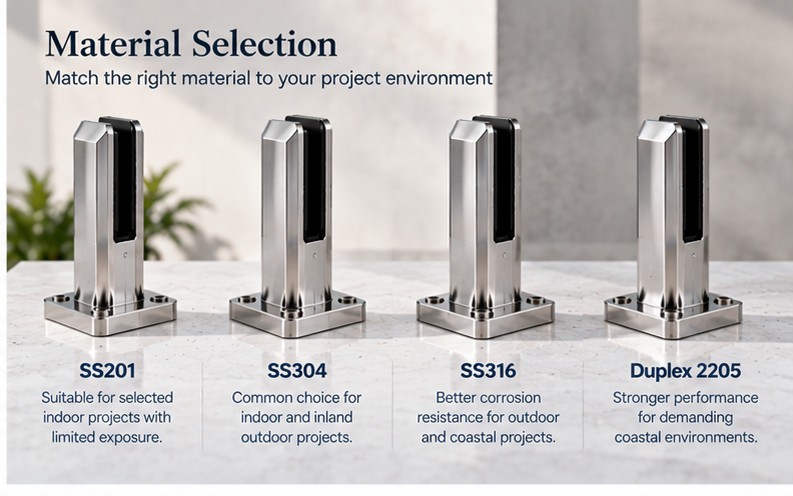
Inland Indoor Projects
For indoor projects in inland areas, SS304 is a common choice. If the budget is limited and corrosion exposure is low, SS201 may also be considered for selected indoor projects.
Inland Outdoor Projects
For outdoor applications, SS304 or SS316 is a better starting point because the hardware faces rain, humidity, and more frequent surface contamination.
Coastal Projects
For a detailed material comparison, see our SS316 vs Duplex 2205 glass spigot guide for pool fencing and coastal projects.
Salt in the air and long-term chloride exposure can cause visible staining on stainless steel. Even SS316 can develop brown or rust-like spotting outdoors without proper cleaning. This is why environment should be confirmed before the quotation is finalized.
3. Choose a Finish That Is Easy to Maintain
Surface finish affects both appearance and long-term maintenance.
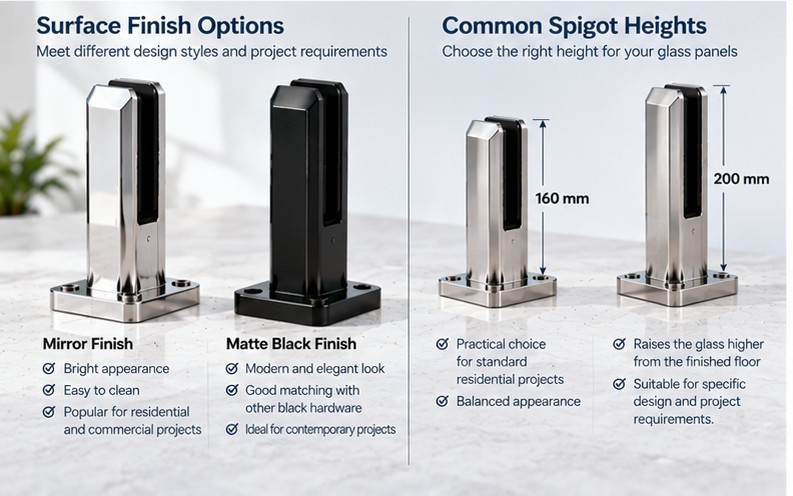
Mirror polished and black finishes are practical choices for many railing projects.
Mirror Finish
A mirror finish works with many architectural styles and is relatively easy to clean. It is common where buyers want a bright stainless steel appearance.
Black Finish
A properly processed black finish is popular for modern residential and commercial projects and can coordinate well with black handrails, glass clamps, and other glass railing hardware.
For coated finishes, approve a physical color sample before mass production. Long-term appearance depends on the coating process, installation environment, cleaning method, and maintenance.
4. Compare 160 mm and 200 mm Glass Railing Spigot Heights
Two common glass railing spigot heights are about 160 mm and 200 mm.
Why a 160 mm Glass Railing Spigot Is a Practical Choice
From site visits and installation experience, the 160 mm model is often a strong value option for standard residential projects.
It keeps the glass closer to the floor, gives the railing a balanced appearance, and works well for commonly used panel sizes when the complete system is installed correctly.
What to Consider With 200 mm Models
A 200 mm spigot raises the glass higher from the finished floor. Some projects may prefer this look, but the larger bottom gap may not suit every design.
If the glass is heavy or oversized, buyers should not rely on extra spigot height as a substitute for correct system design. Stability depends on glass size, fixing points, anchors, substrate, and installation accuracy.
5. Check Glass Railing Spigot Manufacturing Quality
Two spigots can look almost identical but perform differently.
For B2B sourcing, check the manufacturing process. A precision-cast or investment-cast glass spigot can provide good control of the main body shape when properly produced and machined.
Buyers should also inspect machining accuracy, screw threads, gasket fit, surface treatment, and base flatness.
Record the Approved Sample
Before bulk production, record the overall dimensions, product weight, material grade, finish, base dimensions, screw specification, gasket thickness, approved glass range, and packaging method.
Buyers should use the approved sample as the reference for mass production and repeat orders. This helps prevent changes in polishing, screw quality, gaskets, or dimensions.
6. Confirm the Fixing Base for a Glass Railing Spigot
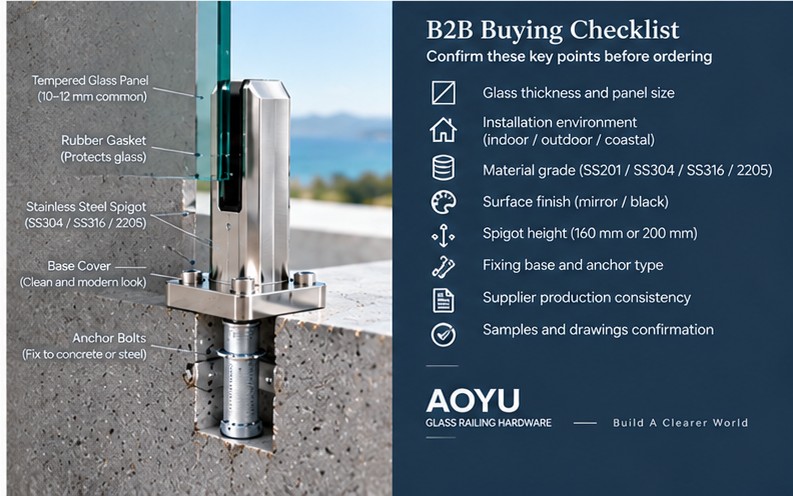
Installers must mechanically fix a glass railing spigot to a suitable supporting structure.
Common bases include concrete, structural steel, reinforced timber, or another engineered substrate.
Before production, confirm the base type, finished floor thickness, waterproofing, anchor type, edge distance, and drainage conditions.
The spigot itself cannot compensate for a weak substrate or unsuitable anchor. For timber installations, confirm that the structure below the finished board is properly reinforced.
7. Review Installation Details Before the Site Starts
Glass spigot installation is relatively straightforward, but alignment still matters.
Installers fix the spigot to the ground or deck with screws or anchors and clamp the glass into the product. In many common designs, the glass does not require drilling.
This can simplify glass processing compared with systems that need holes or complex cut-outs.
Check Alignment Before Final Tightening
Installers should check the spigot centerline, spacing, vertical level, glass gaps, and gasket position before final tightening.
A small error on one panel may seem minor, but it becomes obvious across a long frameless railing. For larger projects, an installation template can improve repeatability.
8. Check Glass Railing Spigot Stock and Supply Consistency
B2B buyers should consider future maintenance before the first shipment.
Ask whether the same glass railing spigot can be supplied again later, especially for hotels, apartments, residential developments, and distributors.
Confirm future availability of replacement spigots, gaskets, screws, covers, and matching finishes.
If a future model uses a different base size, fixing pattern, or glass range, replacement can become difficult even when the product looks similar.
9. Coordinate the Glass Railing Spigot With Related Hardware
Buyers should review a glass railing spigot as part of the complete railing system.
Useful related product categories include Glass Railing Base Shoe, Glass Clamps, Distanțiere din sticlă, Accesorii pentru balustrade, Glass Connectors, and Top Rail systems.
A base shoe provides continuous support along the bottom of the glass, while glass standoffs are often used for side-mounted installations. If the project requires a choice between point support and continuous support, see our glass spigot vs base shoe comparison.Glass clamps and handrail accessories suit other layouts or support requirements.
These related terms also provide natural internal-link opportunities across the AOYU glass railing hardware category.
10. Final B2B Pre-Order Checklist
Before confirming the purchase order, buyers should be able to answer five questions.
Glass
What thickness, height, and width will be used?
Environment
Is the project indoor, outdoor, poolside, or coastal?
Material and Finish
Will the project use SS201, SS304, SS316, or Duplex 2205, and what finish has been approved?
Instalare
What substrate, anchors, spacing, and spigot height will be used?
Supply Consistency
Can the supplier maintain the same dimensions, gaskets, finish, and fixing pattern for future orders?
The best glass railing spigot is not simply the cheapest model or the heaviest-looking one. For B2B buyers, the better product is the one that matches the glass, environment, installation base, and long-term supply requirements. Clear specifications before ordering reduce installation risk, improve appearance, and make future replacement easier.