

For most frameless railing projects, the better choice between a glass spigot and a base shoe depends on glass size, project scale, installation environment, budget, and the support level required. A glass spigot is simpler, faster to install, and well suited to individual panels around 1 m × 1 m, especially in residential applications. Two quality spigots per panel can provide a clean and stable result when the glass, anchors, and substrate are correctly matched. A base shoe costs more, but its continuous aluminum channel supports the full bottom edge of the glass and is usually the stronger choice for heavier panels, long railing runs, commercial projects, and exposed coastal locations. The right system is the one that creates fewer installation and maintenance risks for the specific project.
1. Glass Spigot vs Base Shoe: Point Support vs Continuous Support
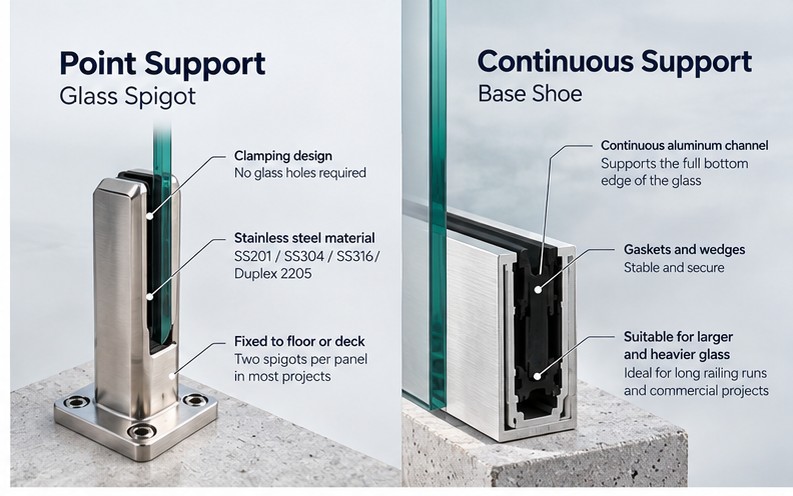
A szklany kranik is a point-support system. The glass sits between individual metal fittings, and one panel normally uses two spigots fixed to the floor or deck. Many clamping-style designs do not require holes in the glass, which simplifies glass processing and replacement.
A base shoe is a continuous-support system. The bottom edge of the glass is held inside an aluminum channel running along the railing line. This gives more continuous support but also requires more material, accessories, and installation work.
Why B2B buyers care
Spigots reduce hardware quantity and simplify replacement. Base shoe systems use more aluminum, gaskets, wedges, and covers, but they are usually more stable for larger or heavier glass.
2. When Is a Glass Spigot Better Than a Base Shoe?
A glass spigot is practical for indoor stairs, home railings, short balcony sections, pool fencing, and individual panels.
Based on practical testing, a panel around 1 m × 1 m can work well with two properly selected spigots when the glass thickness, anchors, and substrate are suitable. This makes the system attractive for residential projects because it looks clean, uses less visible metal, and is easy to install.
160 mm vs 200 mm spigots
For many standard applications, I prefer the 160 mm high model. It keeps the glass closer to the floor and usually gives a more balanced appearance.
A 200 mm model raises the bottom of the glass farther from the floor. If the glass is heavy, that extra height may feel less stable unless the complete system is designed for it. Buyers should still confirm glass size, thickness, fixing method, and local railing requirements.
3. Which Material Should You Choose?
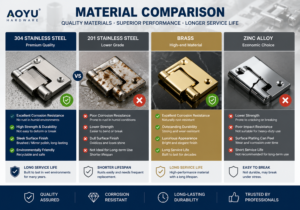
Common glass spigot materials include SS201, SS304, SS316, and Duplex 2205.
SS201 for budget-sensitive indoor projects
If the budget is limited and the installation is in a dry inland indoor environment, SS201 can be considered for selected projects. I prefer a black finish, followed by mirror finish, because minor surface changes are less noticeable.
SS201 is not my preferred option for outdoor, humid, poolside, or coastal projects.
SS304, SS316, and Duplex 2205
SS304 is suitable for many standard indoor and general architectural applications. SS316 offers better corrosion resistance for outdoor or humid environments. However, in long-term coastal exposure, even SS316 may develop brown surface spots or tea-staining when salt deposits remain on the hardware.
For exposed seaside projects, Duplex 2205 is often the stainless steel glass spigot material I prefer because of its stronger resistance to chloride environments.
4. Glass Spigot vs Base Shoe: Which Handles Heavy Glass Better?
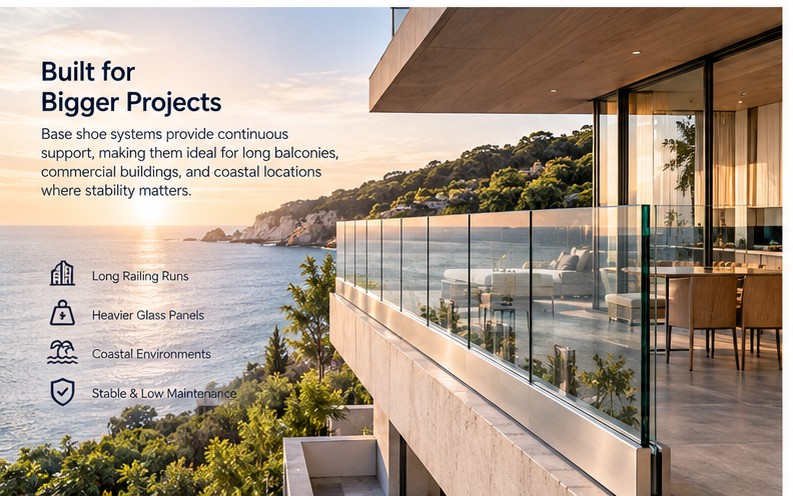
A base shoe generally provides more continuous support than two individual spigots. The aluminum channel surrounds the lower edge of the glass and distributes support along the railing line.
This makes it attractive for long balconies, commercial railings, larger glass panels, and projects where movement should be minimized.
Load capacity must be evaluated as a system
It is not accurate to compare only one kilogram number. Performance depends on glass dimensions, thickness, anchors, substrate strength, fixing spacing, and installation quality.
In general, an aluminum base shoe can provide a more stable support concept for heavier glass than a two-point spigot arrangement. The trade-off is higher material and installation cost.
5. Glass Spigot vs Base Shoe for Coastal Projects
For long-term coastal exposure, I generally prefer an aluminum base shoe when the budget allows.
A suitable base shoe system can reduce the number of exposed stainless steel point fittings along the railing line. With correct aluminum alloy, surface treatment, drainage, fasteners, and maintenance, it can be a strong option for seafront balconies and outdoor commercial projects.
A stainless steel glass spigot can still be used, especially in Duplex 2205, but salt deposits, standing water, and cleaning chemicals should be considered in the maintenance plan.
Whether the project uses a glass spigot or base shoe, the anchor bolts and supporting structure remain critical.
6. Installation: Glass Spigot vs Base Shoe
Both systems normally require screws or anchors fixed into the floor, slab, timber deck, or another structural base.
Glass spigot installation
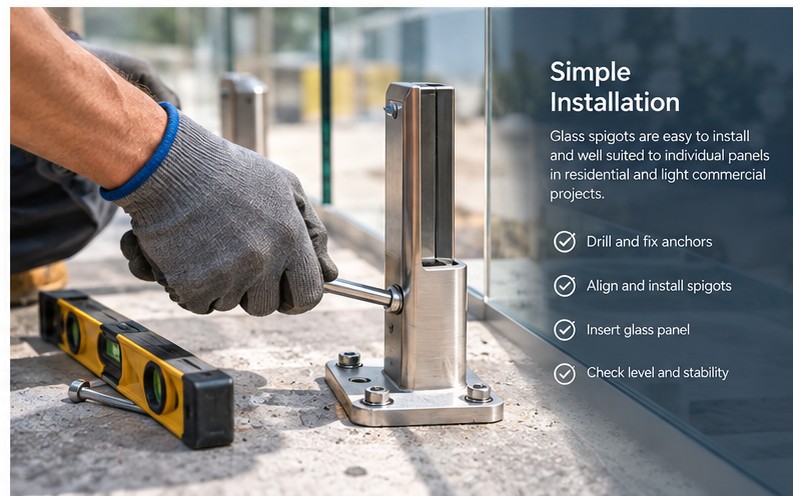
For a typical panel, the installer positions two spigots, marks and drills the fixing points, installs the anchors, aligns the fittings, inserts the glass, and tightens the clamping parts.
For common clamp-style designs, the glass does not need drilling. This reduces glass-processing work and can make replacement easier. The installer should still confirm spacing, level, gasket fit, and anchor depth.
Base shoe installation
A base shoe is fixed continuously along the floor or deck. The glass is inserted into the aluminum channel and secured using the specified wedge, gasket, or clamping system.
Because the bottom of the glass is fully surrounded by the channel, the finished railing can look very clean. However, the system requires more planning for floor tolerance, drainage, covers, and glass alignment.
7. Glass Spigot vs Base Shoe: Cost and Customer Pain Points
A common customer mistake is comparing only the hardware unit price.
A glass spigot usually has a lower initial cost and can reduce installation time on small projects. Individual fittings are also easier to replace.
A base shoe costs more because it uses a continuous aluminum profile and additional accessories. However, its stronger continuous support can improve consistency on larger projects and may justify the extra cost for commercial or heavy-glass applications.
B2B buyers should compare hardware cost + labor + anchors + future replacement + maintenance, not only the price of one fitting.
Another pain point is inconsistent casting quality. If you choose spigots, I strongly recommend precision-cast products. Poor casting can create dimensional variation, uneven surfaces, weak threads, or inconsistent clamping areas that become expensive across large installations.
8. Related Glass Railing Hardware for Internal Links
Useful related product terms include Zaciski do szkła, Szklane podkładki dystansowe, Akcesoria do poręczy, Glass Connectors, oraz Glass Railing Base Shoe.
Side-mounted projects may use glass standoffs, while other architectural layouts may need glass clamps or connectors. If the project includes a top rail, handrail accessories should be coordinated with the glass thickness and panel layout.
Planning these products together helps prevent finish mismatches, incompatible dimensions, and late changes after the glass has already been ordered.
9. Glass Spigot vs Base Shoe: Which Should You Choose?
Choose a szklany kranik when the project uses relatively small individual panels, the budget is controlled, easy installation is important, and a minimal point-supported appearance is preferred.
Choose a base shoe when the project uses heavier or larger panels, long continuous railing runs, commercial areas, or when greater continuous support is preferred. It is also my preferred option for many coastal projects when the budget supports it.
Practical buying rule
For a typical residential panel around 1 m × 1 m, two quality precision-cast spigots can be a practical solution. For larger or heavier glass, do not simply add more spigots without reviewing the complete design. At that point, a base shoe may be the better system.
Wnioski
Ten glass spigot vs base shoe decision depends on glass size, project scale, environment, installation method, and budget. Glass spigots offer simple installation, lower cost, easy replacement, and a clean appearance for residential and individual-panel applications. Base shoes cost more but provide continuous support and are often better suited to large, heavy, commercial, or coastal railing projects.
For inland indoor projects with limited budgets, SS201 may be considered selectively. SS304, SS316, and Duplex 2205 provide stronger options for more demanding environments. For spigot systems, choose precision-cast products and match the fitting height to the real panel size rather than choosing the largest model automatically.
Most importantly, evaluate the glass, hardware, anchors, substrate, and installation method as one complete bezramowy system balustrad szklanych before placing a bulk order.