

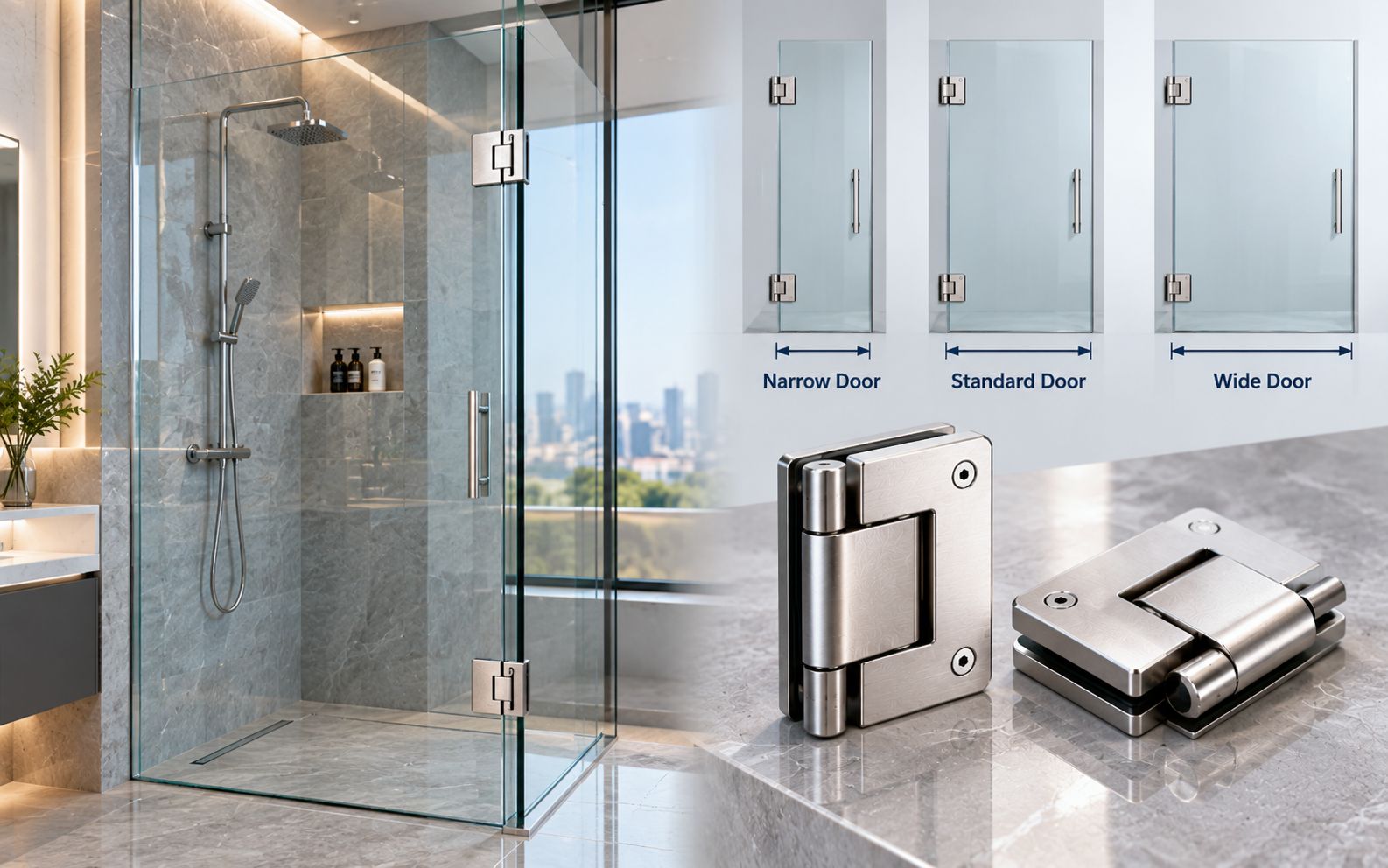
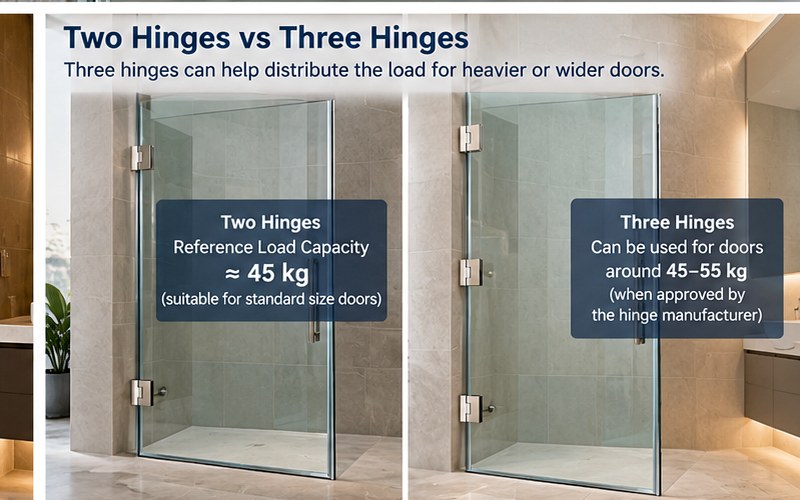
Door width affects shower door hinge load capacity because a wider glass panel creates greater leverage on the hinges, even when the total glass weight stays within the nominal rating. For a common frameless shower door, one pair of hinges (two pieces) may carry a rating of around 45 kg and commonly suits 8–10 mm tempered glass. However, buyers should not check kilograms alone. They should calculate glass weight, confirm door width and height, and compare all three values with the hinge specification. If a door is too heavy or too wide, it can sag, loosen screws, shift out of alignment, or place dangerous stress on the glass. For doors around 45–55 kg, three compatible hinges may help distribute the load when the hinge manufacturer approves that configuration.
1. Why Door Width Affects Shower Door Hinge Load Capacity
A hinge supports more than the vertical weight of the glass. The farther the outer edge of the door extends from the hinge line, the greater the turning effect on the hinge and its fixing screws. Buyers should not automatically treat a narrow and a wide 40 kg door as the same application because extra width increases leverage and sagging risk.
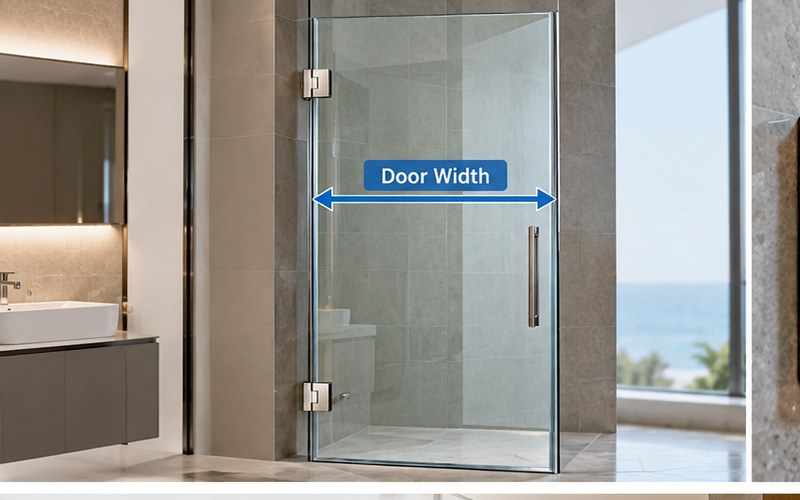
For B2B buyers, a common pain point is sending only glass thickness and estimated weight while omitting door width. The hinge may look suitable on paper but perform poorly after installation. Always send full glass dimensions before approval.For a broader comparison of hinge types, glass requirements, materials, and installation options, see our Shower Door Hinges Buying Guide.
2. Start by Calculating the Glass Door Weight
Practical Weight Calculation for 8 mm and 10 mm Glass
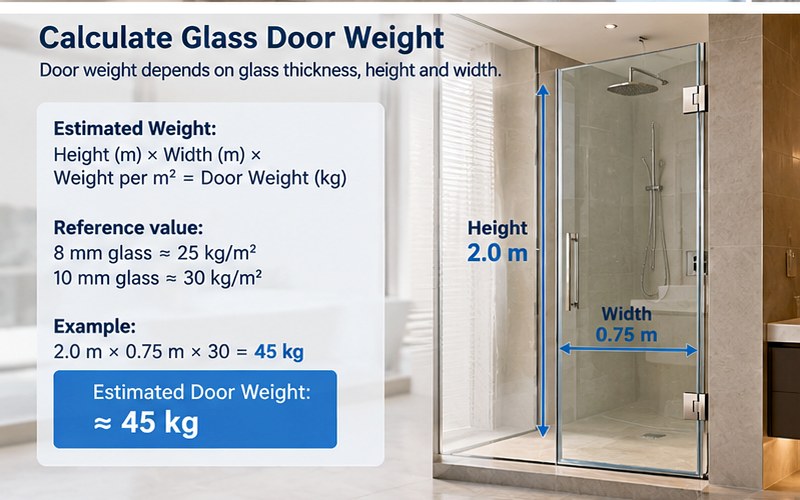
A practical purchasing estimate starts with glass area. Use: door height (m) × door width (m) × approximate glass weight per square meter = estimated door weight. For the reference values used in this guide, 8 mm glass is approximately 25 kg/m² and 10 mm glass approximately 30 kg/m². Buyers should use the supplier’s or glass processor’s confirmed value for final engineering decisions.
For example, if a 10 mm glass door is 2.0 m high and 0.75 m wide, the estimate is 2.0 × 0.75 × 30 = 45 kg. That already reaches the reference capacity of a common two-hinge set. If the same glass becomes wider, the weight rises and the leverage on the hinges also increases. Therefore, both dimensions matter before selecting the hardware.For more guidance on matching hinge capacity with glass size, see our guide to pivot hinges for glass shower doors.
3. What Does a 45 kg Shower Door Hinge Load Capacity Mean?
A common glass shower door hinge set consists of two hinges with a reference load capacity of about 45 kg. Manufacturers often specify these hinges for 8–10 mm tempered glass. However, buyers should not interpret “45 kg” as permission to use any 45 kg glass door regardless of width, height, hinge spacing, installation substrate, or hinge design.
The permitted door size should follow the manufacturer’s technical data. Some hinges suit narrower doors, while heavy duty shower door hinge models may allow larger panels. Wall fixing, glass cut-outs, gaskets, screw torque, and installation accuracy also affect performance.
4. What Happens When Shower Door Hinges Exceed Load Capacity?
Overloading does not always cause an immediate failure. The first sign may be a door that slowly drops and no longer lines up with the fixed glass panel or magnetic seal. Installers may then tighten the screws repeatedly without solving the underlying load problem.
As stress continues, screws can loosen, the hinge can shift, and concentrated pressure can develop around the glass cut-out. In a severe case, excessive stress can damage the glass or cause the door to lose secure support.Tempered glass can fail suddenly when an edge or cut-out area is compromised, so hinge capacity should be treated as a safety issue rather than only an adjustment issue.
5. When Can Three Hinges Be Used?
If a glass door exceeds the normal two-hinge reference capacity but remains around 55 kg, buyers may consider a three-hinge arrangement when the hinge supplier approves it.If a glass door exceeds the normal two-hinge reference capacity but remains around 55 kg, buyers may consider a three-hinge arrangement when the hinge supplier approves it.Three support points can distribute the load and reduce the demand placed on each hinge.
Use the Same Hinge Style and Matching Glass Cut-Outs
For a three-hinge door, the hinges must belong to the same compatible design family. A practical configuration may use two heavy-duty hinges plus one lighter supporting hinge, but all three models must work together as a compatible system.The visible style, pivot geometry, and especially the glass cut-out dimensions must match. Do not combine unrelated hinges simply because their screw holes look similar.Before tempering the glass, review our shower door hinge cut out guide to confirm dimensions, corner radius, edge finishing, and hinge alignment.
Glass preparation is critical because tempered glass cannot be casually reworked after tempering. The three hinge positions should be confirmed on the approved drawing before the glass is produced. Buyers should also ask the supplier for recommended hinge spacing rather than placing the third hinge arbitrarily.
6. How Door Width and Height Affect Shower Hinge Load Capacity
Door width is important, but height and hinge position also influence stability. Poor hinge spacing can leave the top or bottom of the door less controlled. B2B buyers should therefore send a complete door drawing instead of choosing only from a load-capacity number.
For frameless installations, confirm each hinge cut-out and the top, bottom, and any third-hinge positions. This keeps the glass processor and hardware supplier on the same drawing.
7. Check the Wall or Fixed-Glass Connection
A correctly selected hinge can still fail to perform if the supporting structure is weak. For wall-to-glass hinges, the wall fixing must be strong enough for the door weight and repeated opening cycles. Tile alone should not be treated as the structural support. The installer needs a suitable substrate and appropriate anchors behind the finished surface.
For glass-to-glass hinges, the fixed panel and its support system must also be suitable. Related products such as shower glass clamps, pręty wsporcze do kabiny prysznicowej, U-channels, and stabilizing bars can affect the rigidity of the complete enclosure. These are useful product terms for internal links because hinge performance depends on the whole shower structure.
8. Do Not Ignore Gaskets, Screws, and Glass Cut-Out Quality
Hinge capacity depends on small components as well as the metal body. Gaskets protect the glass and help create controlled clamping pressure. Screws must maintain the specified tightening force, while machined surfaces should sit correctly against the glass. Poor gaskets or inaccurate cut-outs can create movement even when the nominal hinge capacity is sufficient.
For repeat orders, keep the approved hinge sample, glass drawing, gasket specification, screw type, material, and finish on record. This reduces replacement-batch differences.
9. Material and Finish for Commercial Shower Projects
Stainless steel shower door hinges are widely used for frameless enclosures because they combine strength with a clean architectural appearance. Depending on the project, buyers may specify SUS304 or another suitable stainless grade, together with mirror polish, satin or hairline finish, matte black, or other finishes. Material and surface treatment should be confirmed separately from the load rating.For project sourcing, see our guide on How to Choose Shower Door Hinges for B2B Projects for additional selection considerations.
For hotels, apartments, and repeat projects, finish consistency also matters. A hinge with the correct capacity but a visibly different finish can still create a project complaint.
10. B2B Pre-Order Checklist for Shower Door Hinges
Glass and Door Information
Before ordering, provide glass thickness, door height, door width, estimated glass weight, opening direction, and whether the door is wall-to-glass or glass-to-glass. If the calculated weight approaches the two-hinge limit, ask the supplier to confirm the permitted width and whether a three-hinge arrangement is appropriate.
Hardware and Installation Information
Confirm hinge model, quantity, load rating, glass cut-out drawing, hinge spacing, gasket specification, screw type, wall substrate, and required finish. If the shower enclosure also uses a shower door handle, glass clamp, shower support bar, shower door seal, U-channel, or sliding shower hardware, coordinate these components before glass production.For complete enclosure planning, see our guide on jak dobrać okucia do drzwi prysznicowych for frameless shower projects.
11. Shower Door Hinge Load Capacity: Final Selection Rule
The safest way to evaluate shower door hinge load capacity is to check both weight and width. Do not treat kilograms as the only limit. A common two-hinge set may support about 45 kg on suitable 8–10 mm glass. However, buyers must still follow the manufacturer’s permitted door dimensions. Calculate the glass weight first. Then confirm width, height, hinge spacing, substrate, and glass preparation.
If the door is slightly above the normal two-hinge range and around 55 kg, three compatible hinges can be considered to share the load when approved by the hinge supplier. Using two heavy-duty hinges plus one compatible supporting hinge can help reduce sagging, but all three must follow the same design system and matching glass cut-outs. This approach gives B2B buyers a more reliable basis for selecting glass shower door hinges and helps prevent loose screws, misalignment, glass damage, and costly site replacements.