


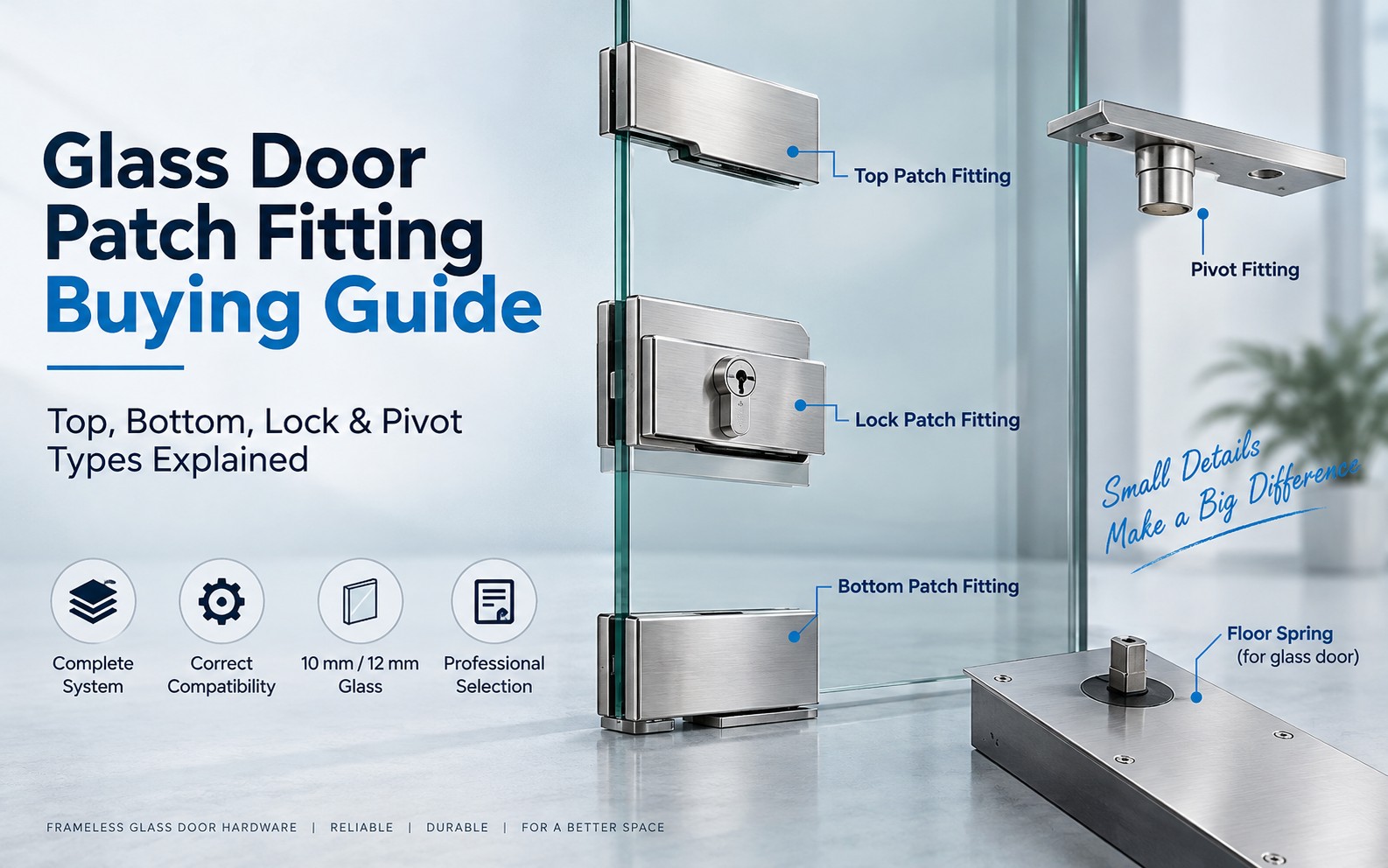
B2B buyers should choose the right glass door patch fitting as part of one complete frameless door system, not as an isolated metal part. B2B buyers should confirm the top patch, bottom patch, pivot, lock patch, floor spring interface, glass thickness, and glass cut-out before ordering. In many markets, patch-fitting families are commonly described as DORMA-type, MAB-type, Crown-type, or VVP-type. Parts from different families may look similar, but their pivot centers, spindle interfaces, plate sizes, and glass preparation can differ. For offices, shops, and glass partitions using 10 mm or 12 mm tempered glass, the safest approach is to keep the patch fittings and floor spring within the same verified dimensional family and confirm the correct gaskets before production.
1. Understand the Complete Glass Door Patch Fitting System
A system okuć nakładkowych do drzwi szklanych combines several fittings around the same frameless glass door. Each part has a different function, but all of them must work around the same pivot line and glass preparation. Many purchasing problems begin when buyers select the top, bottom, lock, and pivot pieces separately because the finishes look similar, then discover on site that the components do not align.
Top Patch Fitting
Installers typically position the top patch fitting at the upper corner of the moving glass door. Depending on the system, it connects to a top pivot, transom patch, frame, or overhead support. Its location helps define the vertical pivot axis, so Therefore, buyers should select the top and bottom components as one coordinated set.
Bottom Patch Fitting
The bottom patch fitting connects the door to the floor spring spindle or lower pivot assembly. For a floor-spring glass door, this is one of the most important compatibility points. The spindle position, insert shape, center distance, and bottom patch geometry must match the selected floor spring family.
Lock Patch Fitting
A glass door lock patch fitting adds locking function while keeping the frameless appearance compact. Depending on the project, it may be used as a center lock, corner lock, or floor-level lock. Buyers should confirm lock direction, cylinder type, strike position, and finish.
Pivot and Connector Types
Pivot fittings complete the door rotation and support arrangement. Some doors use a floor spring below and a pivot above; others connect to fixed glass through transom or side patch fittings. For fixed-glass connections, buyers should also check compatible łączniki do drzwi szklanych when planning the complete system.
The complete pivot line must remain accurate from top to bottom.
2. Do Not Mix Incompatible Glass Door Patch Fitting Families
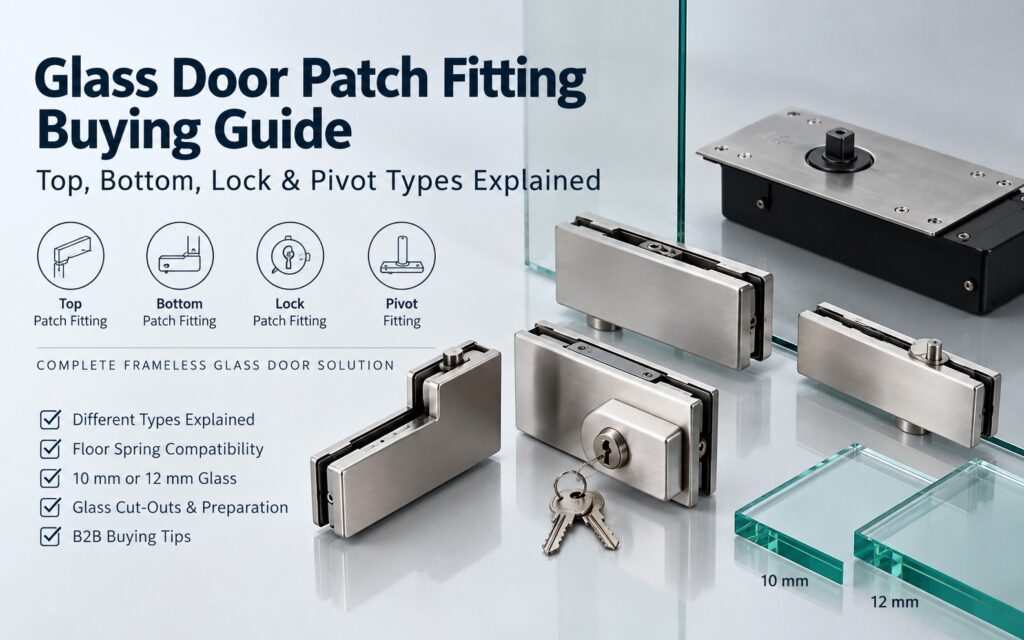
One of the biggest B2B pain points is mixing products that appear interchangeable but are not dimensionally compatible. DORMA, MAB, Crown, and VVP are common reference names buyers may hear in different markets. Suppliers also offer compatible “type” systems based on these dimensional families.
Why the Floor Spring Must Match the Patch Family
If a project uses an MAB-type top patch, bottom patch, lock patch, and pivot arrangement, use a floor spring with the matching MAB-type interface unless the supplier confirms cross-compatibility. Using a Crown-type bottom patch with an MAB-type floor spring can create problems even when the products look nearly identical. The spindle shape, pivot center, and glass notch may not match.
For bulk orders, ask the supplier to confirm the complete system family, floor spring model, bottom patch interface, top pivot, and technical drawing. A mismatch discovered after glass tempering can cost much more than the hardware itself.
3. Confirm 10 mm or 12 mm Glass Before Ordering
Office glass partitions and commercial frameless doors commonly use 10 mm or 12 mm tempered glass, but both thicknesses cannot always use the same gasket combination. Buyers should confirm this detail before shipment.
Gasket Thickness Is a Small Part With a Big Effect
Patch fittings clamp the glass through internal gaskets or paper/fiber pads. If the supplier prepares an order for 12 mm glass but the site uses 10 mm glass, the gasket pack may be too thin to hold the glass securely after tightening. Too many gaskets can make assembly difficult.
Before production, state the glass thickness, door width, door height, approximate weight, opening direction, patch-fitting family, and floor spring model. For repeat projects, record the approved gasket combination with the hardware model.
4. Approve Glass Cut-Outs for Glass Door Patch Fittings Before Tempering
Top, bottom, lock, and pivot patch fittings require prepared holes, notches, or edge cut-outs in the glass. Because tempering makes later glass modifications difficult, buyers should approve the hardware drawing before the glass factory starts production.
Buyers should check notch shape, hole diameter, spacing, edge distance, pivot centerline, and plate dimensions. Never assume two similar-looking glass door patch fitting models use the same glass preparation, especially when changing suppliers or system families.
5. Match Glass Door Patch Fittings With the Correct Floor Spring
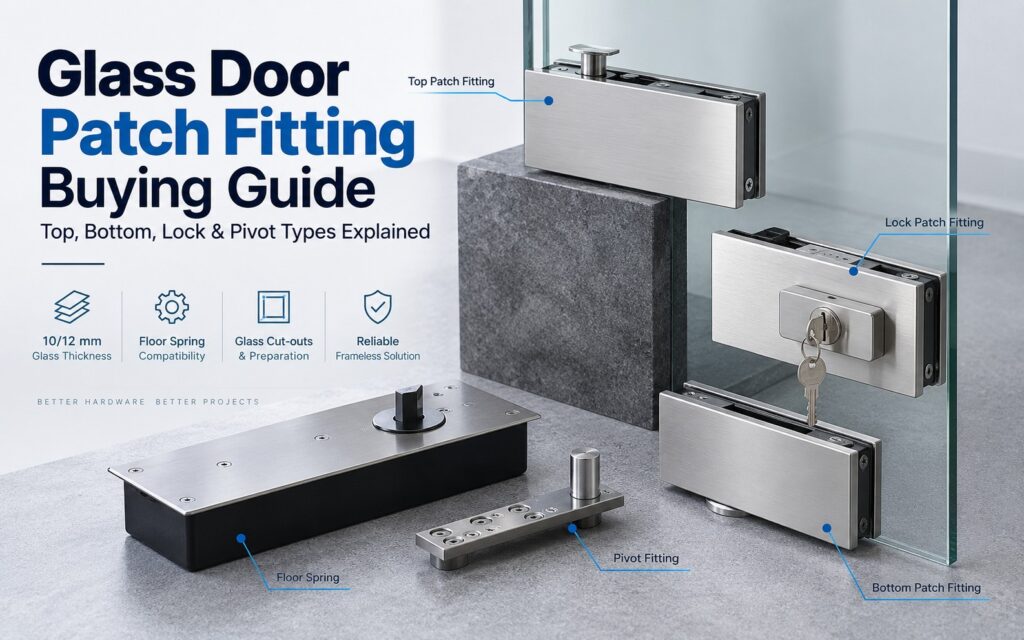
A floor spring for glass door applications controls opening, closing, and centering. The patch fittings transfer the door load into that floor spring and upper pivot system. Therefore, the floor spring should be specified together with the patch fittings, not added later.
Check Door Size and Operating Function
Before choosing the floor spring, provide the door width, height, glass thickness, approximate weight, expected traffic level, and required opening angle. Also confirm hold-open or non-hold-open function, closing speed, and spindle interface. The supplier should confirm that the bottom patch and floor spring work together.
6. Typical Application Scenarios
Glass door patch fitting systems are widely used for office partitions, retail entrances, hotel interiors, banks, showrooms, commercial buildings, and frameless meeting-room doors. Their main advantage is a clean appearance with less visible framing.
In office projects, 10 mm glass is common for lighter partitions, while 12 mm glass may be selected for larger doors. The final thickness should still follow the door dimensions and project requirements rather than a universal rule.
7. B2B Buyer Pain Points to Check Before a Bulk Order
Large projects expose small specification errors quickly. A sample may work perfectly, while mass-production fittings later show differences in plate dimensions, pivot inserts, screws, gaskets, finish tone, or lock cylinders. These variations can slow installation across dozens of doors.
Before mass production, record the patch-fitting model, system family, glass thickness, material, finish, dimensions, screw set, gasket set, lock cylinder, floor spring interface, pivot direction, packaging, and approved drawing. The approved sample should become the production reference.
Finish Consistency Matters Across the Whole Door
Patch fittings are installed next to other visible hardware. Buyers should compare the finish with related glass door handles, glass door locks, floor spring cover plates, and other frameless glass door hardware. Satin, mirror, matte black, gold, and custom finishes can look inconsistent when sourced from different batches.
8. Related Products to Review as One System
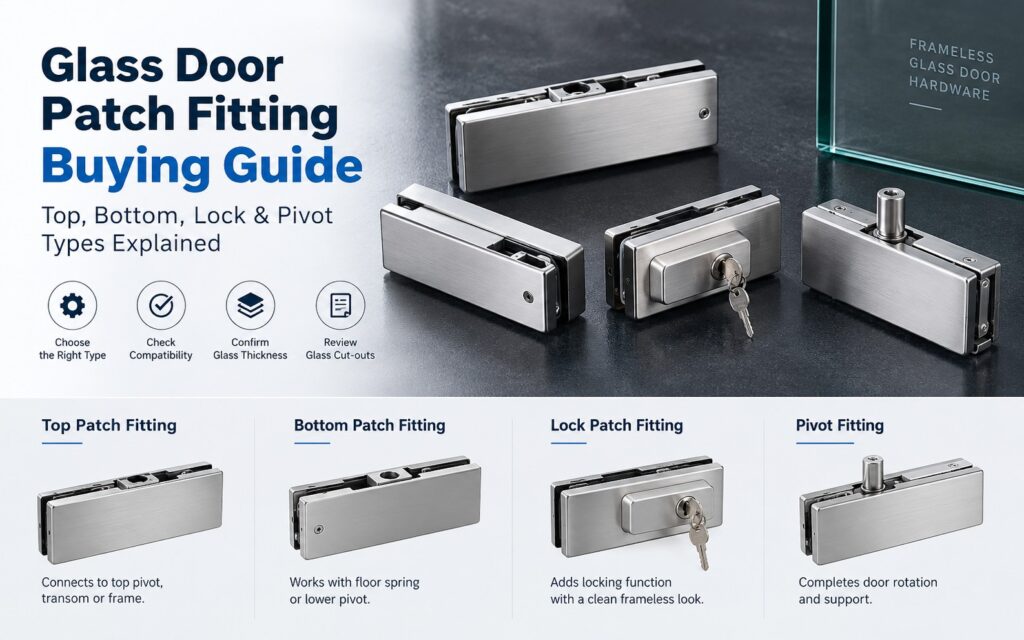
A commercial frameless glass door is rarely built from patch fittings alone. Useful internal-link terms include glass door floor spring, szklane klamki do drzwi, glass door locks, glass door connectors, door pivots, and frameless glass door hardware.
If a project includes fixed glass panels, related glass clamps or connectors may also affect alignment. Planning these products together reduces the risk of hardware that fits individually but conflicts once the complete door is assembled.
For projects that also include shower enclosures, buyers can review our Przewodnik po okuciach do drzwi prysznicowych for related hinge, handle and glass-fitting selection.
9. A Practical Pre-Order Checklist for B2B Buyers
Before ordering, confirm the glass thickness, door size, opening direction, top patch, bottom patch, lock patch, pivot type, floor spring family, spindle interface, glass cut-out drawing, gasket quantity, finish, lock cylinder, sample approval, and spare-part availability.
For future maintenance, keep the original drawings and model references. Replacing a patch fitting years later becomes difficult if the new component uses a different notch, pivot center, or floor spring interface.
Wnioski
The best glass door patch fitting is the one that works as part of a verified complete door system. Top, bottom, lock, pivot, and floor spring components should be selected around the same dimensional family, correct glass thickness, and approved glass cut-out. For 10 mm and 12 mm office glass doors, gasket selection is especially important because the wrong pad thickness can leave the glass loose or make installation difficult. B2B buyers should avoid mixing DORMA-type, MAB-type, Crown-type, or VVP-type components unless compatibility is confirmed by drawings or physical testing. Approving the complete hardware set before tempering the glass can reduce installation delays, replacement glass, and costly project rework.