

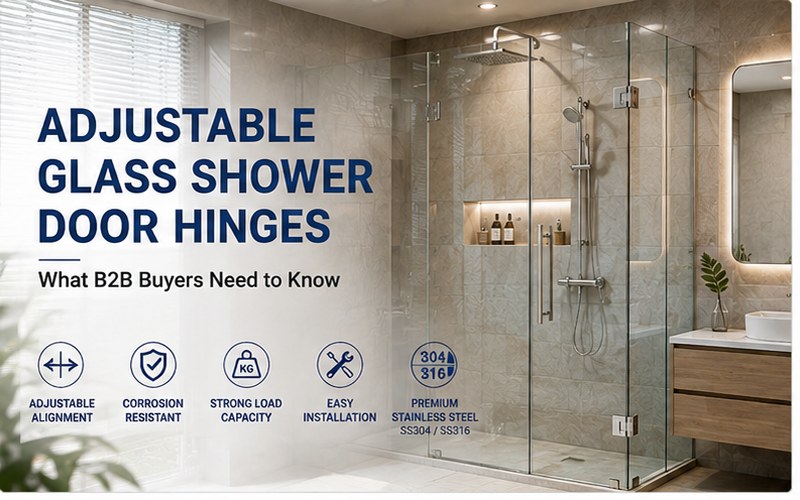
Adjustable glass shower door hinges give installers limited control over door alignment, closing position, or hinge angle during and after installation. For B2B buyers, that adjustability can reduce installation problems caused by small variations in walls, tiles, glass processing and panel positioning. However, adjustable shower door hinges cannot correct major construction errors, incorrectly drilled glass or an unsuitable hinge specification. Therefore, before buying for hotels, apartments, or commercial projects, buyers should confirm the adjustment range, required tools, compatible glass thickness, load conditions, and whether installers can make adjustments after installing the door. In addition, buyers should compare stainless steel hinge material guide, glass-to-glass hinges, and wall-to-glass configurations before approving glass drawings and bulk production.
For a broader overview of related components, buyers can also read our complete shower door hardware guide.
Why Adjustable Shower Door Hinges Matter in B2B Projects
For large B2B projects, adjustable glass shower door hinges can help installers manage minor alignment differences more efficiently.
An installer can often adjust a single shower door manually during installation without creating a major problem.
A 200-room hotel project is different.
However, large projects often repeat the same small installation variations across many bathrooms. One tiled wall may lean slightly inward, another may be a few millimeters out of position, while glass panels from different production batches may also show minor dimensional tolerances.
For this reason, adjustable shower door hinges can be valuable in large projects.
They can help installers:
- Improve door alignment
- Correct small closing-angle differences
- Reduce uneven gaps
- Align moving glass with fixed panels
- Improve door centering
- Reduce repeated removal and reinstallation
For contractors, these small improvements can save significant labor across an entire project.
However, However, buyers should consider adjustment an installation aid, not a substitute for accurate glass processing and correct construction.—not a substitute for accurate glass processing and correct construction.
What Does “Adjustable” Actually Mean?
Not all hinges described as adjustable work in the same way.
This is one of the most important points B2B buyers need to understand.
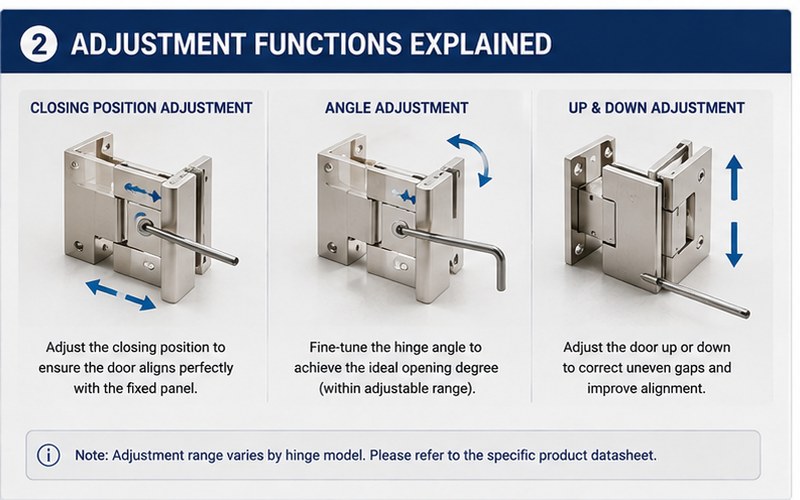
Adjustable Closing Position
Some adjustable shower door hinges allow the installer to change the final resting or closing position of the door.
For example, if the glass does not close exactly in line with a fixed panel, the installer may be able to reset the hinge position within a limited range.
This is particularly useful for frameless shower enclosures where visible glass gaps need to remain consistent.
Adjustable Hinge Angle
Certain hinge designs allow controlled changes to the angle between the moving and fixed components.
This can be useful when the installation is close to 90°, 135° or 180°, but the actual construction geometry differs slightly.
However, buyers should never assume that adjusting a 90° hinge can turn it into a completely different hinge type.
Alignment Adjustment
Some hardware provides a small amount of alignment correction through mounting plates, clamping positions or internal mechanisms.
This can help compensate for minor site tolerances.
When buyers search for how to adjust glass shower door hinges, they should first identify which adjustment mechanism the actual hinge uses.
What Adjustable Hinges Cannot Fix
This is where many project problems begin.
Buyers sometimes assume adjustable hinges can solve almost any installation issue. They cannot.
Incorrect Glass Holes or Cut-Outs
If the glass processor has placed the holes in the wrong positions an adjustable hinge may not solve the problem.
After tempering, glass processors generally cannot re-drill tempered glass. Therefore, an incorrect hole position may require a replacement panel.
Major Wall Misalignment
If a wall is significantly out of plumb, the correct solution may involve wall preparation, shims, profiles or changes to the glass dimensions.
Installers should never force a hinge beyond its intended adjustment range.
Wrong Door Weight
Adjustment does not increase structural capacity.
If the glass door is too heavy or too wide for the selected hinge, changing the hinge position will not solve the load problem.
Therefore, buyers should select heavy duty shower door hinges based on actual glass dimensions and tested performance.
Different Types of Shower Door Hinges Require Different Adjustment
The available types of shower door hinges affect how adjustment works.
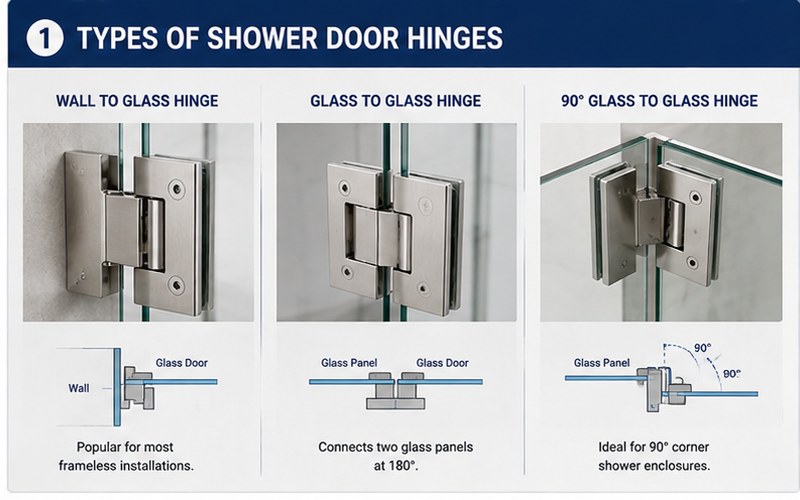
| Hinge Type | Main Connection | Adjustment Consideration |
| Wall-to-Glass | Wall to moving glass | Wall alignment and mounting position |
| Glass-to-Glass | Fixed glass to door | Alignment between two glass panels |
| 90° Hinge | Right-angle layout | Corner angle and closing position |
| 135° Hinge | Angled enclosure | Accurate panel geometry |
| 180° Hinge | In-line panels | Door-to-fixed-panel alignment |
| Adjustable Hinge | Various layouts | Controlled correction within set range |
Wall-to-Glass Shower Door Hinges
With wall to glass shower hinges, the quality and position of the wall mounting surface are critical.
If tile thickness varies or the wall is slightly out of alignment, an adjustable design may help improve the final glass position.
However, the wall must still provide adequate structural support.
Glass-to-Glass Shower Hinges
With glass to glass shower hinges, the moving door relies on the fixed glass panel and its supporting system.
Therefore, buyers should consider the adjustable range together with the fixed panel, glass clamps, channels, or shower door support bars.
Stainless Steel Adjustable Shower Door Hinges
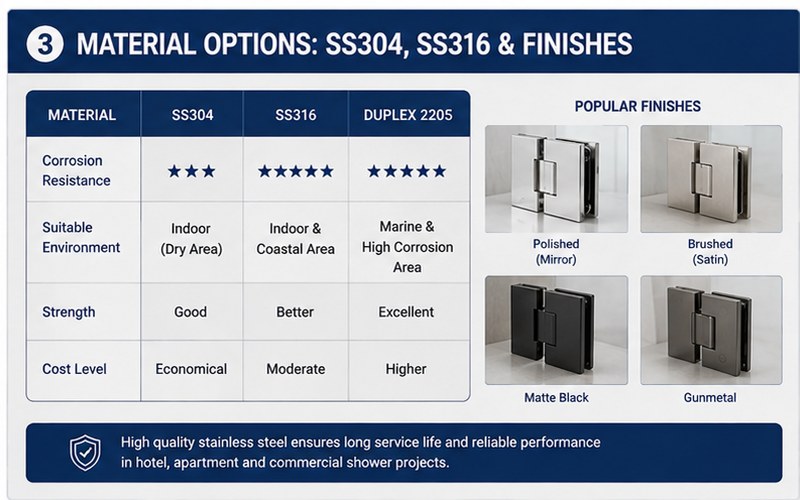
For B2B projects, stainless steel shower door hinges offer a practical combination of strength, corrosion resistance, and finish options.
For standard indoor shower applications, many B2B buyers choose SS304 because of its durability and corrosion resistance.
However, buyers may prefer SS316 for projects exposed to coastal air or higher chloride levels.
For adjustable models, buyers should check more than the visible stainless steel plates.
When selecting adjustable glass shower door hinges, buyers should also compare material grade, corrosion resistance, and tested load capacity.
Ask about:
- Internal pivot components
- Adjustment screws
- Pins
- Bushings
- Gaskets
- Fasteners
An attractive stainless steel cover does not automatically mean the complete adjustment mechanism uses the same material quality.
For project procurement, this becomes important because internal components experience repeated movement and tightening.
How to Adjust Glass Shower Door Hinges Safely
There is no single universal method to adjust glass shower door hinges.
The correct procedure depends on the hinge design.
However, a professional installation process usually follows several basic principles.
Step 1: Support the Door
Before loosening any adjustment screws, installers should properly support the glass door.
Allowing the entire door weight to hang on a partially loosened hinge may create unnecessary stress on the glass and hardware.
Step 2: Make Small Adjustments
Adjustment should be gradual.
Moving the door too far at once can change glass gaps, seal contact and alignment with adjacent panels.
Step 3: Tighten in the Correct Sequence
The installer should follow the manufacturer’s tightening sequence and torque recommendations where provided.
Uneven tightening can affect gasket compression and glass position.
Step 4: Test the Full Door Movement
After adjustment, check:
- Opening movement
- Closing position
- Glass clearance
- Seal contact
- Hinge centering
- Screw security
For large projects, AOYU HARDWARE recommends confirming the installation method on a sample or mock-up before applying the same process across multiple rooms.
Adjustment and Shower Door Seals Must Work Together
Door alignment is not only about the hinge.
Shower door seals also affect the final closing position.
If the gap is too small, the seal may create excessive resistance. If the gap is too large, water control may become less effective.
Therefore, installers should check the hinge position, glass dimensions, and seal profile together.
This is particularly important for magnetic seals or vertical seals between two glass panels.
Coordinate Hinges With Other Shower Door Hardware
In addition, project teams should plan adjustable hinges as part of the complete shower door hardware system.
Relevant components include:
Ручки для душевых дверей
Handle position affects how users apply force when opening the door.
Зажимы для стекла
Fixed panels may depend on glass clamps for shower doors for stability.
Support Bars for Shower Doors
Large fixed panels can require shower door support bars to control movement.
Уплотнители для душевых дверей
Seal thickness affects final door gaps and closing resistance.
Shower Sliding Systems
If the bathroom does not provide enough swing clearance, glass sliding shower door hardware may offer a more suitable solution than an adjustable hinged door.
These related product terms are also suitable internal-link opportunities.
What B2B Buyers Should Ask Before Ordering
Before approving adjustable hinges for mass production, ask the supplier:
- What exactly can installers adjust?
- What is the adjustment range?
- Can installers make adjustments after installation?
- Does adjustment require special tools?
- What glass thickness does the hinge support?
- What door dimensions and weight has the supplier tested?
- Does adjustment affect load capacity?
- Are technical and glass-cutting drawings available?
- Can the supplier provide replacement adjustment parts?
- Is there an installation guide or video?
A supplier that cannot clearly explain these points may create unnecessary risk for large projects.
B2B buyers can also learn how to evaluate a shower door hardware manufacturer before placing bulk or repeat orders.
Standardize the Adjustment Process for Large Projects
For hotel and apartment projects, consistency is more valuable than having unlimited adjustment options.
Once project teams have tested and approved the hinge and installation method, they should standardize:
- Glass preparation
- Hinge position
- Screw sequence
- Door gap
- Adjustment procedure
- Seal position
- Final inspection
This makes installation more predictable and reduces differences between installers.
AOYU HARDWARE can support B2B shower-door projects with shower door hinges, stainless steel hinge material guide, glass-to-glass hinges, wall-to-glass hinges, shower door handles, glass clamps, support bars and related shower hardware.
Providing door dimensions, glass thickness, drawings and project requirements before ordering makes hinge selection and adjustment planning more accurate.
FAQ: Questions B2B Buyers Really Ask About Adjustable Shower Door Hinges
1. How much misalignment can an adjustable shower door hinge normally correct?
There is no universal adjustment range. It depends on the specific hinge design. Buyers should request the exact adjustment range from the supplier rather than assuming all adjustable hinges can correct the same amount of deviation.
2.Can I adjust the hinge after installing the shower glass?
Many adjustable hinges allow some correction after installation, but the process varies. Installers can make some adjustments with the door in place, while other adjustments require them to loosen the hinge partially or support the glass first.
3. My shower door keeps dropping slightly. Should I keep adjusting the hinge?
Not automatically. Repeated door drop can indicate loose fasteners, insufficient gasket grip, incorrect installation, excessive door width or unsuitable hinge capacity. Therefore, installers should identify the cause before making repeated adjustments.
For complete system selection, buyers should also understand how to choose the right shower door hardware for different glass and installation requirements.
4. Can adjustable hinges compensate for incorrect glass hole positions?
Usually not if the hole or cut-out error is significant. Adjustable hinges provide limited alignment correction and cannot correct major glass-processing mistakes. Compare the glass drawing with the hinge drawing before deciding whether installers can still use the panel.
5. Do adjustable shower door hinges support less weight than fixed hinges?
Not necessarily. Load capacity depends on the individual hinge design, materials and testing conditions. Buyers should compare the manufacturer’s recommended glass dimensions and door weight instead of assuming adjustable hardware is weaker.
6. Should I choose adjustable hinges for every hotel shower-door project?
Not always. Adjustable hinges work especially well when site tolerances are a concern. However, highly standardized installations may only require a fixed hinge.The best choice depends on the glass layout, installer experience, door size and project tolerance requirements.