

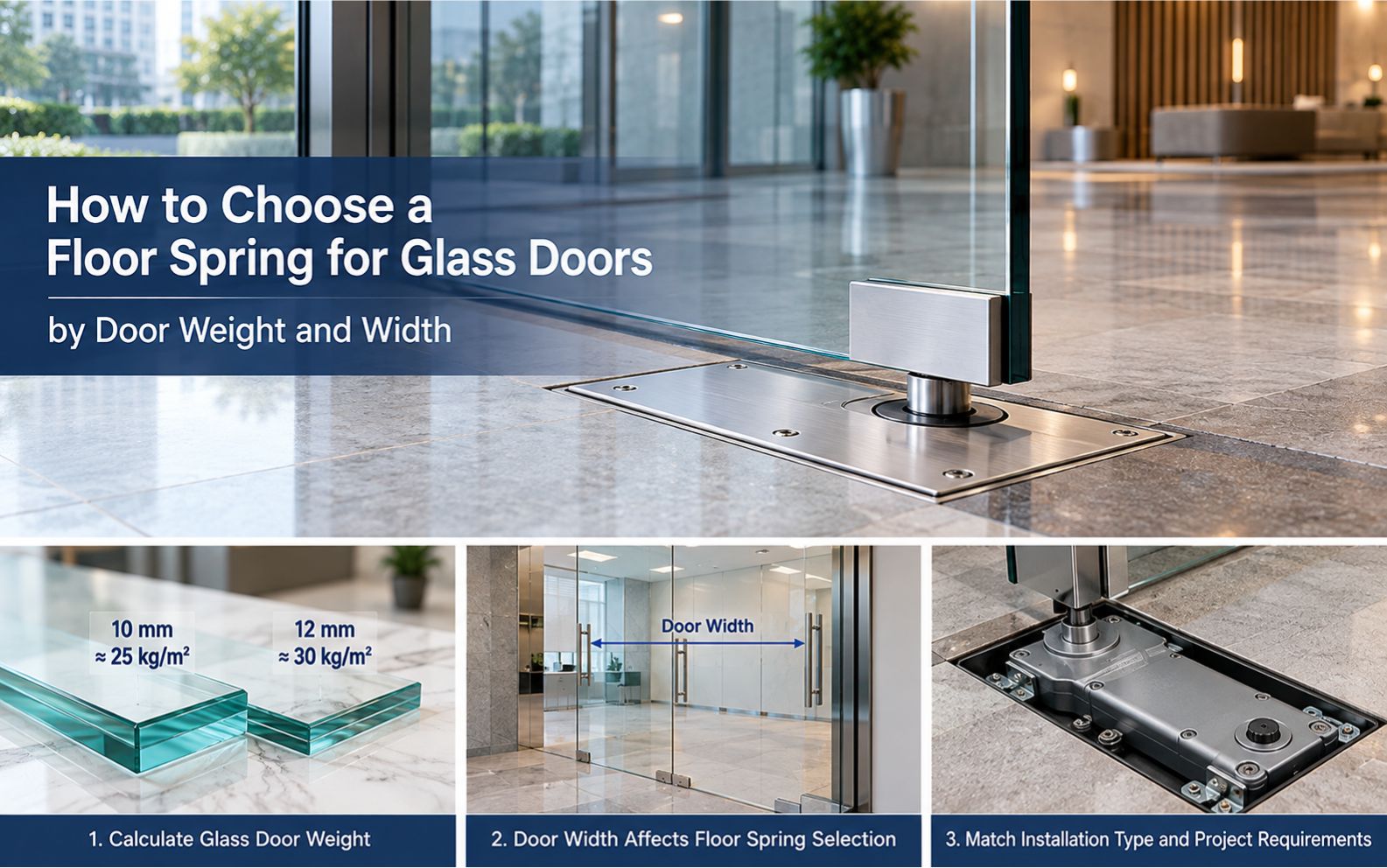
To choose the right floor spring for glass door projects, start with the actual door weight and door-leaf width, then check glass thickness, opening frequency, installation method, and site conditions. A floor spring that is too light may close poorly, wear faster, or struggle with a wide door, while an unnecessarily heavy model can make operation uncomfortable. Before requesting a quotation, give the supplier the glass thickness, door height, door width, estimated weight, and application. For example, 10 mm glass weighs about 25 kg/m² and 12 mm glass about 30 kg/m². Offices, hotels, retail entrances, and other high-frequency doors normally need more durable capacity than a lightly used residential door.This guide also explains when a no-dig floor spring is suitable for renovation projects compared with a concealed in-ground model.
1. Calculate Door Weight for a Glass Door Floor Spring
Door weight is the first practical specification because the closer body must control the moving mass through thousands of opening and closing cycles. Buyers often send only a photo or ask for a “standard” model. That creates unnecessary risk because two doors that look similar can have very different weights.
A Simple Glass Weight Formula
For a quick purchasing estimate, use the glass area multiplied by the approximate weight per square meter. As a practical reference, 10 mm glass is about 25 kg/m², while 12 mm glass is about 30 kg/m². A 10 mm glass door measuring 1.0 m × 2.2 m is therefore approximately 1.0 × 2.2 × 25 = 55 kg. Hardware, holes, fittings, and project tolerances should still be considered before final model approval.
For B2B orders, send the supplier the exact thickness, height, width, and door configuration. This allows the factory to recommend a floor spring for glass door use with a suitable safety margin instead of selecting only from a nominal weight label.
2. How Door Width Affects Glass Door Floor Spring Selection
A common buyer pain point is checking kilograms but ignoring width. A wider glass door creates greater leverage around the pivot, so a 70 kg narrow door and a 70 kg wide door do not place the same demand on the mechanism. For this reason, floor spring selection should always consider both maximum door weight and maximum recommended leaf width.
Practical Floor Spring Capacity Guide
| Floor Spring Class | Maximum Door Weight | Recommended Max. Width | Typical Application |
| 80 kg class | ≤80 kg | ≤900 mm | Small office door, typically 10 mm glass |
| 100 kg class | ≤100 kg | ≤1000 mm | Standard retail door, 10/12 mm glass |
| 120–130 kg class | ≤130 kg | ≤1100 mm | Wider door, 12 mm tempered glass |
| 150 kg class | ≤150 kg | ≤1250 mm | Lobby entrance, 12/15 mm glass, higher wind exposure |
| 200 kg+ heavy duty | ≥200 kg | ≥1300 mm | Oversized glass or laminated glass |
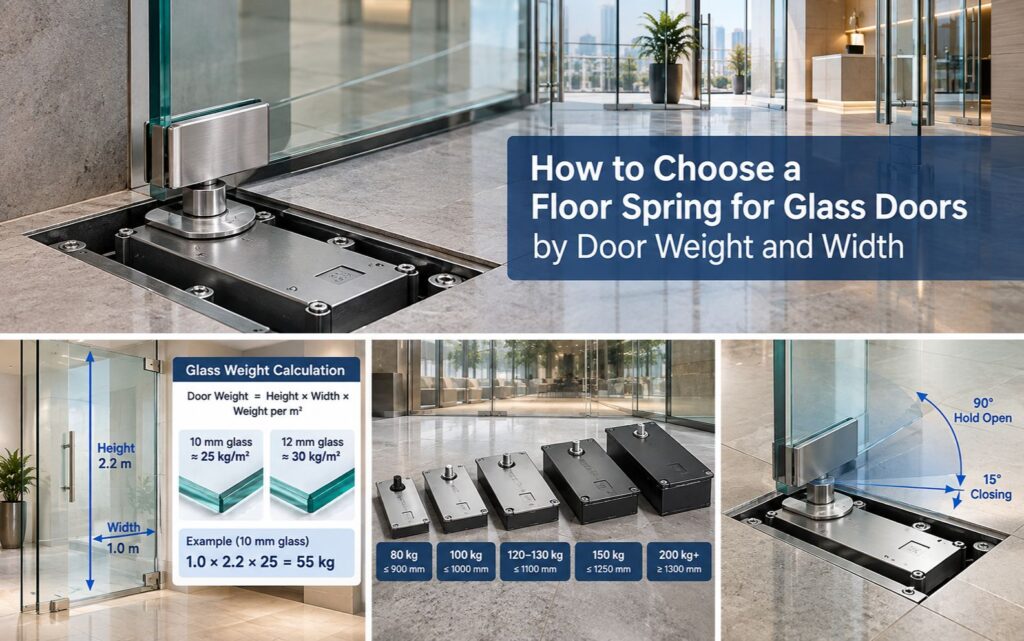
These figures are a practical purchasing guide rather than a universal engineering limit. Actual suitability also depends on the floor spring design, pivot geometry, door hardware, wind pressure, installation accuracy, and manufacturer specifications.
3. High-Traffic Office and Hotel Glass Doors Need More Reserve Capacity
Office doors, hotel glass doors, lobby entrances, and busy commercial doors may open and close many more times per day than a private interior door. In these applications, buyers should not select capacity only because the calculated door weight falls just below a model’s maximum rating. Choosing appropriate reserve capacity can improve operating stability and service life.
Many conventional floor spring products use an iron or steel main body inside the floor box, combined with a stainless steel cover plate; a SUS304 cover is a common specification for a clean architectural finish. Buyers should confirm the internal body construction, cover material, hydraulic performance, closing-speed adjustment, and cycle requirements with the supplier rather than judging quality only by the visible plate.
4. No-Dig Floor Spring vs Concealed In-Ground Floor Spring
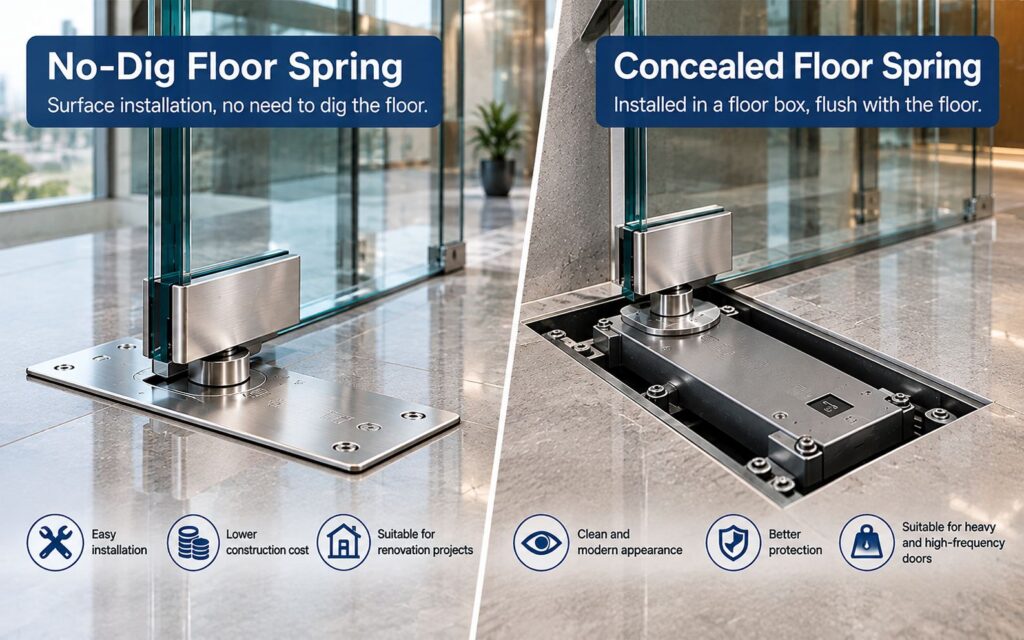
Floor springs for frameless glass doors are commonly divided into two installation approaches: no-dig or shallow-installation systems, and traditional concealed models installed below the finished floor. The correct choice depends on project stage, floor structure, appearance, load, and maintenance access.
No-Dig Floor Spring
A no-dig floor spring is useful when deep floor excavation is difficult or when renovation speed matters. It can reduce disruption to finished floors and may suit retrofit shops, offices, and selected commercial interiors. However, buyers still need to confirm door weight, width, fixing conditions, and compatibility with the pivot system.
Concealed In-Ground Floor Spring
A traditional concealed floor spring sits below the finished floor and leaves mainly the cover plate visible. This installation is widely used for frameless glass entrances, hotel doors, office doors, and commercial projects where a clean appearance and proven heavy-duty configuration are important. The installer must coordinate the floor box depth, waterproofing, centerline, pivot position, and finished-floor level before installation.
5. Match a Glass Door Floor Spring With the Complete Hardware System
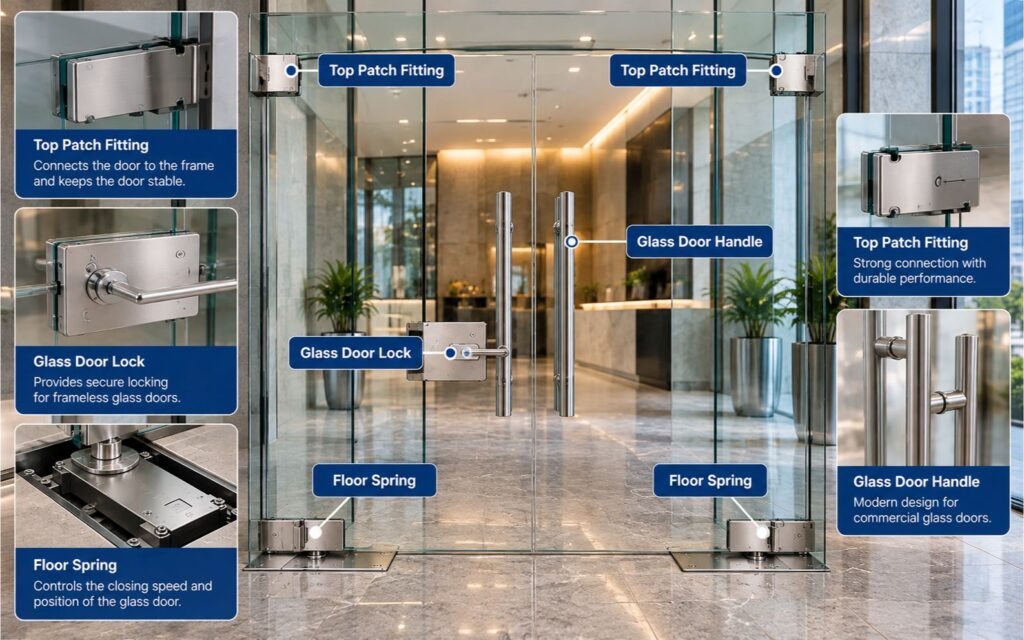
A floor spring does not work alone. The complete door system may include a top patch fitting, bottom patch fitting, glass door lock, glass door handle, pivot fitting, glass door clip, and other frameless glass door hardware. These related products should be checked together because spindle interfaces, pivot centers, glass cut-outs, and door geometry affect installation.
For internal linking on a product website, buyers researching a glass door floor spring may also need information about Patch Fitting, Glass Door Handles, Glass Door Locks, and Glass Door Connectors. Presenting the system as a coordinated package helps B2B customers reduce compatibility mistakes and simplifies replacement-part sourcing.
6. Check Opening Frequency, Closing Control, and Site Conditions
Two projects with the same 90 kg door may still need different solutions. A hotel entrance operating all day has a different duty cycle from a meeting-room door. Wind pressure, air-conditioning pressure differences, door stops, traffic flow, and whether the door is single or double leaf can also affect user experience.
Buyers should ask whether closing speed and final latching speed are adjustable and whether the selected heavy duty floor spring is intended for the expected traffic level. For exterior or semi-exterior entrances, drainage and protection around the floor box also deserve attention. Water entering the installation cavity can shorten component life even when the visible cover is stainless steel.
7. Common B2B Buying Mistakes
The first mistake is ordering by price or model number without sending door dimensions. The second is selecting exactly at the maximum rated capacity with no consideration for high traffic or width. The third is mixing a floor spring with unrelated patch fittings before confirming the spindle and pivot interface. Another frequent problem is finalizing the floor after the installer discovers that the concealed floor box needs more depth or a different center position.
For repeat orders, keep the approved model, spindle type, cover dimensions, floor-box size, maximum opening angle, adjustment functions, and matching fittings on record. This is especially useful for hotel chains, office projects, distributors, and contractors who may need replacement units months or years later.
8. What Information Should Buyers Send Before Ordering?
A supplier can recommend the correct floor spring for frameless glass door projects much faster when the inquiry includes complete technical information. Send the glass thickness, door height, door width, calculated door weight, single- or double-door configuration, indoor or outdoor location, expected opening frequency, preferred installation type, and any existing patch fitting or pivot details.
Use Weight Calculation as the Starting Point
If the exact weight is unknown, calculate it from glass area first. For example, a 1.0 m × 2.2 m door in 10 mm glass is approximately 55 kg. The supplier can then compare that weight with the 80 kg, 100 kg, 120–130 kg, 150 kg, or 200 kg+ class while also checking the door width. This approach is more reliable than choosing a model from appearance alone.
9. Floor Spring for Glass Door: Final B2B Selection Rule
The best floor spring for glass door applications is the model that matches both the calculated door weight and the actual door width, while providing suitable durability for the traffic level and installation environment. Small 10 mm office doors may fit an 80 kg class, standard shop doors often move into the 100 kg range, and wider 12 mm doors may require 120–130 kg capacity. Large lobby doors, wind-exposed entrances, laminated glass, and oversized panels should move into heavier classes when the manufacturer confirms the application.
For AOYU B2B buyers, the safest purchasing process is simple: calculate the glass weight, provide the full door dimensions, identify the application and traffic frequency, choose no-dig or concealed installation, and confirm compatibility with the complete glass door hardware system before mass production. This reduces wrong-model orders, site rework, premature wear, and replacement problems.