

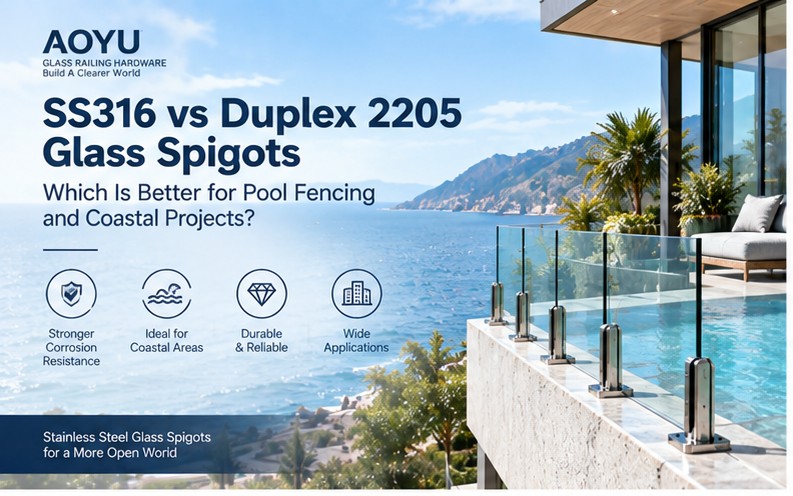
For indoor staircases and protected glass railing projects, an SS316 stainless steel glass spigot is generally more than sufficient. For pool fencing, outdoor glass balustrades, coastal balconies, and locations exposed to sea air for long periods, Duplex 2205 is usually the safer long-term choice. SS316 has strong corrosion resistance, but prolonged chloride exposure can still cause brown surface spots or “tea staining,” especially when salt remains on the surface. Duplex 2205 offers higher resistance to chloride-related corrosion and is better suited to demanding exterior environments. AOYU’s regular stocked glass spigots are commonly designed for 10-12 mm glass, while models for 16, 18, 20, and 22 mm glass are also available. Material options include SUS304, SUS316, and Duplex 2205.
1. Why Material Choice Matters Near Pools and the Sea
A glass spigot may look simple, but material choice affects appearance, maintenance, and service life. Typical applications include indoor staircases, frameless glass fences, balcony railings, terraces, swimming pool fencing, hotels, residential projects, and commercial outdoor spaces. Indoor projects usually face limited corrosion exposure, while pool and coastal projects may face humidity, chlorides, salt spray, and years outdoors.
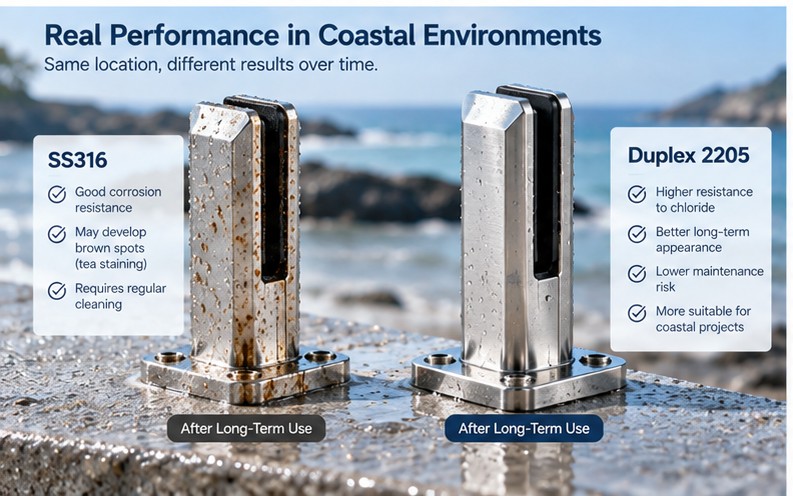
A common B2B pain point is choosing SS316 because suppliers often call it “marine grade” and expecting the surface to remain unchanged forever. SS316 performs very well, but it is not maintenance-free. In harsh coastal conditions, salt deposits can still create brown spots or tea-staining over time.
For buyers who want lower maintenance risk in exposed coastal installations, Duplex 2205 is often more suitable.
2. SS316 Stainless Steel Glass Spigot for Indoor and Outdoor Projects
Where SS316 Works Well
An SS316 stainless steel grifo de vidrio is a strong choice for indoor staircases, hotel interiors, commercial railings, residential projects, and many outdoor applications where chloride exposure is moderate.
Compared with SUS304, SS316 provides better corrosion resistance and is often selected for humid areas and poolside projects. Indoors, it is generally more than sufficient. Near the sea, visible surfaces may still develop tea-staining if maintenance does not remove salt deposits regularly.
For a broader overview of material, glass thickness, load capacity, and installation options, see our guide on how to choose a glass spigot for frameless glass railings.
Main B2B Concern With SS316
The main issue is often appearance and maintenance rather than immediate performance. Buyers should consider cleaning frequency, drainage, exposure, and maintenance expectations before selecting the material.
3. Duplex 2205 Stainless Steel Glass Spigot for Coastal Exposure
Duplex 2205 provides higher strength and stronger resistance to chloride-related corrosion than standard 300-series stainless steel.
Where 2205 Is the Better Choice
Duplex 2205 is especially suitable for seafront balconies, coastal hotels and villas, outdoor glass railings near salt water, exposed pool fencing, and marine-area architectural projects.
For projects that remain exposed to sea air for long periods, AOYU generally recommends considering 2205 rather than relying only on SS316.
Not every outdoor project requires Duplex 2205; the key is matching material to the real environment.
4. SUS304, SUS316 and 2205: How Buyers Should Compare Them
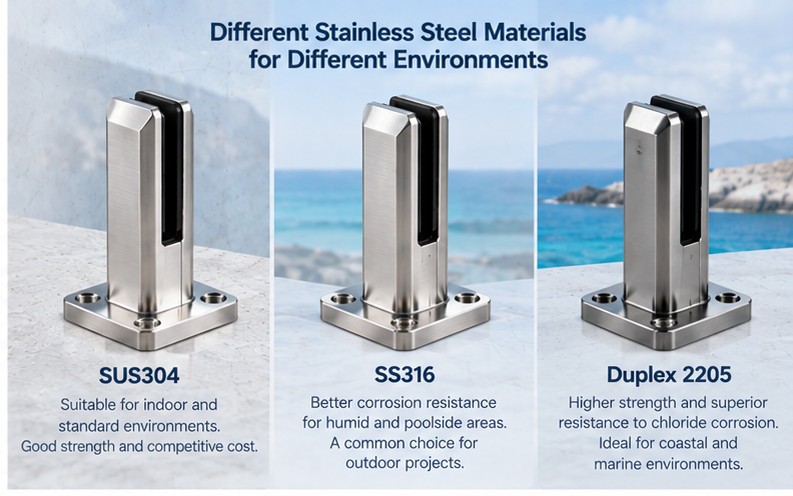
SUS304
For many indoor glass railing applications and standard environments, SUS304 is a practical choice. It offers good strength, clean appearance, and competitive cost. It offers good strength, clean appearance, and competitive cost.
SUS316
SUS316 is better for humid, poolside, and many outdoor installations. It provides improved chloride resistance and is a common choice for premium stainless steel glass spigot projects.
Dúplex 2205
Duplex 2205 should be considered for demanding coastal and marine exposure. It also offers higher mechanical strength.
The best purchasing question is: “Which material gives the required durability with the lowest maintenance and replacement risk?”
5. Stainless Steel Glass Spigot: Glass Thickness and Heavy-Glass Options
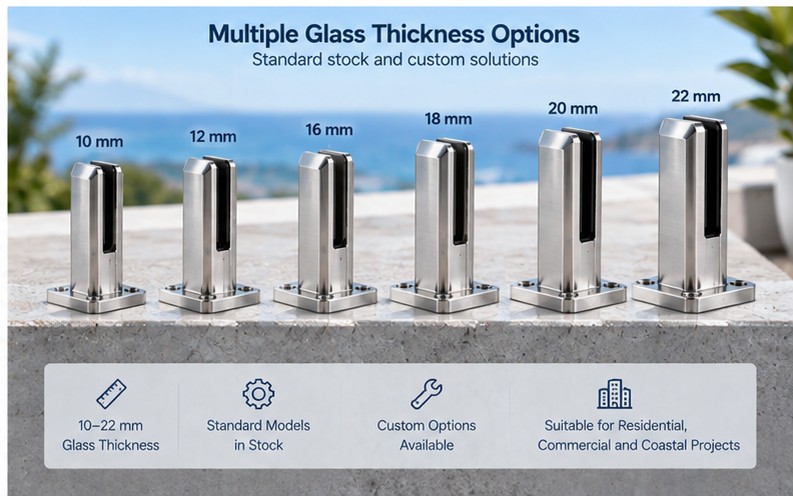
Most regular AOYU glass spigot models are stocked for 10-12 mm glass. This range covers many frameless glass railing, pool fence, and staircase applications.
For heavier architectural glass projects, AOYU also supplies glass spigots for 16 mm, 18 mm, 20 mm, and 22 mm glass.
Do Not Choose by Glass Thickness Alone
Glass thickness is only one part of the specification. Buyers should also provide panel height, panel width, approximate weight, installation location, and the number of spigots used per panel.
A wide panel can create more leverage at the fixing points than a narrow panel, even when their weight is similar. Project buyers should therefore send complete glass dimensions, not only the thickness.
6. Stainless Steel Glass Spigot Load Capacity for Regular Models
For AOYU’s regular stocked configuration, a typical reference load is about 45 kg per two glass spigots when installed under the intended conditions.
However, buyers should not treat this as a universal engineering limit. Actual performance depends on glass size, spigot spacing, anchor bolts, substrate strength, edge distance, and installation quality.
Why the Same Weight Can Create Different Loads
A narrow 45 kg panel and a wider 45 kg panel do not create the same mechanical demand. The wider panel creates greater leverage around the fixing points.
For large projects, confirm the recommended glass dimensions and installation conditions before bulk ordering.
7. Installation: Fixed to the Ground or Timber Without Drilling the Glass
One advantage of many glass spigot systems is that the glass does not need to be drilled.
The spigot is fixed to concrete, steel, or reinforced timber, while the glass is held by the clamping system and suitable gaskets.
Surface-Mounted Installation
A typical installation sequence is:
- Confirm the spigot centerline and panel layout.
- Mark the fixing holes.
- Install the correct anchors or fasteners.
- Secure the spigot base.
- Insert the correct gaskets.
- Position and level the glass.
- Tighten the clamping screws evenly.
- Recheck alignment before final tightening.
Because the glass is not drilled, site adjustment and future replacement can be easier than with some point-fixed systems.
Important Installation Pain Point
A high-quality stainless steel glass spigot cannot compensate for a weak base.
For timber installations, the board and supporting structure must be strong enough. For concrete installations, anchor type, concrete quality, waterproofing, and edge distance should be checked before drilling.
8. Stainless Steel Glass Spigot for Coastal Installation
Choosing 2205 reduces corrosion risk, but installation and maintenance still matter.
Coastal projects should avoid areas where water and salt can remain trapped around the base. Good drainage and periodic cleaning help protect the surface.
Installers should also avoid contamination from carbon-steel tools or grinding dust, because surface contamination can create rust-like marks even when the spigot itself is stainless steel.
For long-term exterior projects, buyers should specify the spigot material, screws, fasteners, surface finish, and maintenance expectations in the purchase order.
9. Coordinate Stainless Steel Glass Spigots With the Railing System
A glass spigot is only one part of the complete frameless glass railing hardware system.If the project team is still deciding between point support and continuous support, see our glass spigot vs base shoe comparison for a detailed system-level evaluation.
Related products may include glass railing base shoes, glass clamps, glass standoffs, accesorios para pasamanos, top rails, and glass connectors.
A glass railing base shoe may suit continuous support, while glass standoffs can suit side-mounted installations. Glass clamps and handrail accessories may also be required.
Reviewing the complete system early makes it easier to coordinate finish, material grade, installation method, and future replacement parts.
Conclusion: Which Material Should You Choose?
For indoor staircases and protected glass railing applications, SUS304 or SS316 may meet the project requirement. Meanwhile, an SS316 stainless steel glass spigot offers a strong balance of corrosion resistance, appearance, and cost for pool fencing and many standard outdoor projects.
However, for long-term outdoor exposure in coastal, seafront, or marine environments, Duplex 2205 is usually the better option because it provides stronger resistance to chloride-related corrosion and reduces tea-staining and maintenance risk.
The final choice should consider environment, glass thickness, panel size, load, fixing base, and installation method together. AOYU offers regular 10-12 mm glass spigots in stock, along with models for 16, 18, 20, and 22 mm glass, with SUS304, SUS316, and Duplex 2205 material options.