

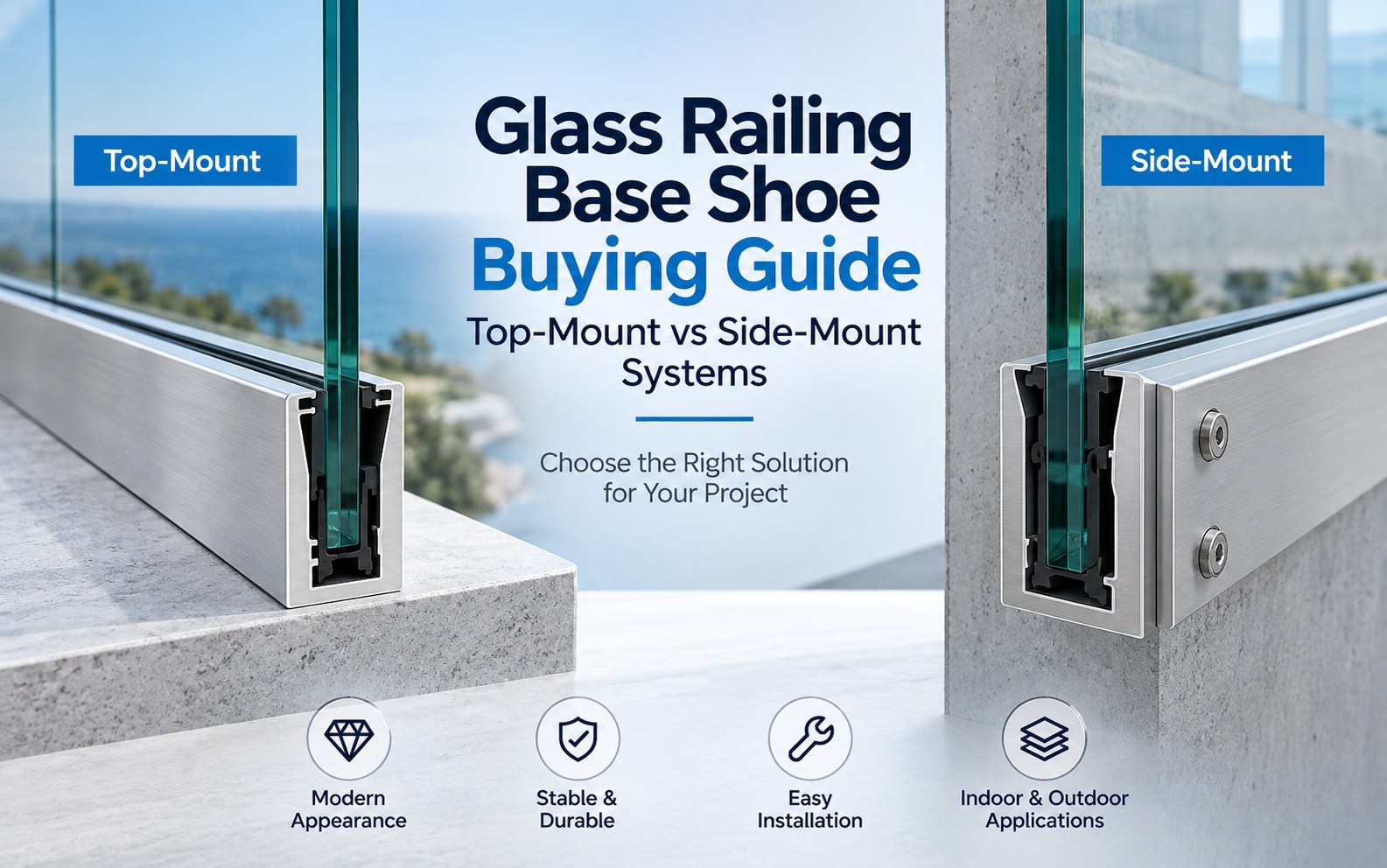
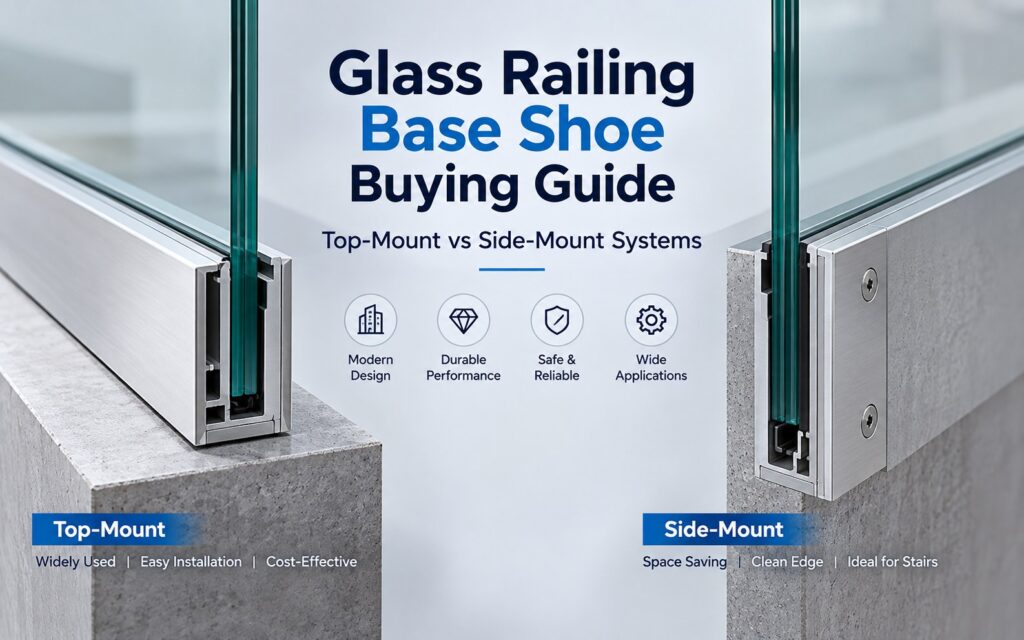
For most frameless glass railing projects, a top-mount glass railing base shoe is usually more practical because it is widely used, easier to install, and normally costs less in product and labor than a side-mount system. Top-mount systems work well for indoor and outdoor railings in commercial buildings, apartments, villas, balconies, and terraces. Side-mount base shoes save floor space and are useful on narrow stairs or slab edges where a top-mounted channel would reduce usable width. However, side-mount installation is usually more complex and expensive. Neither system is automatically better in every project. The right choice depends on space, substrate, glass size, drainage, load requirements, appearance, and installation conditions.
1. What Is a Glass Railing Base Shoe?
A glass railing base shoe is a continuous aluminum channel that supports the bottom edge of frameless glass panels. Instead of holding each panel at a few points, the base shoe supports the glass along a continuous line. This creates a clean architectural appearance for balconies, stairs, terraces, commercial buildings, apartments, villas, and frameless glass railing systems.
For B2B buyers, the main decision is often how to mount it: top-mount or side-mount.
Why This Decision Matters
A wrong mounting choice can increase labor cost, reduce usable space, complicate waterproofing, or create installation problems at the slab edge. Buyers should compare the complete installation condition rather than the profile alone.
2. How Does a Top-Mount Glass Railing Base Shoe Work?
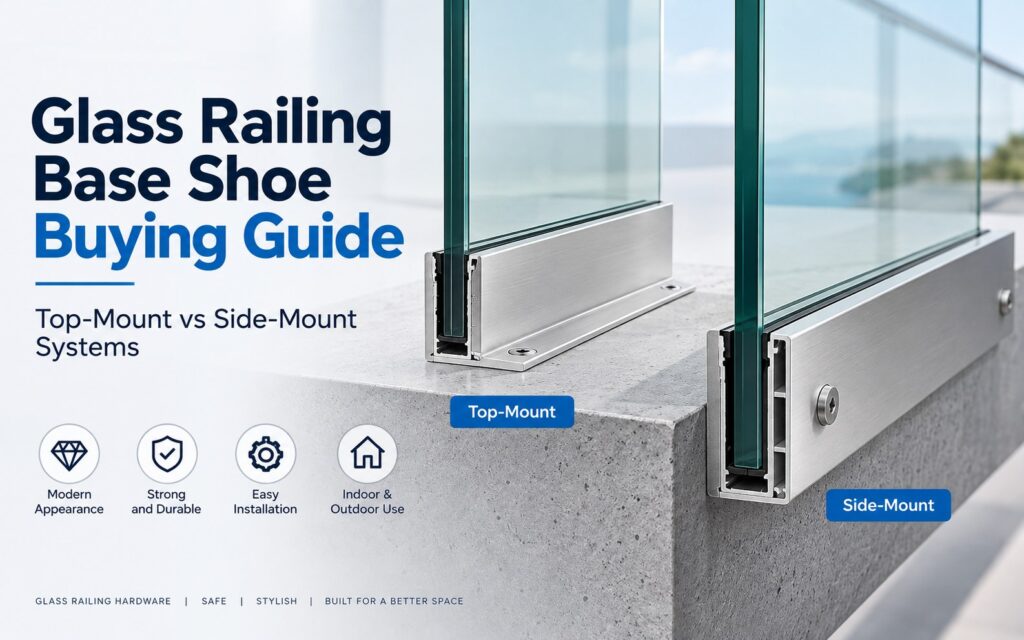
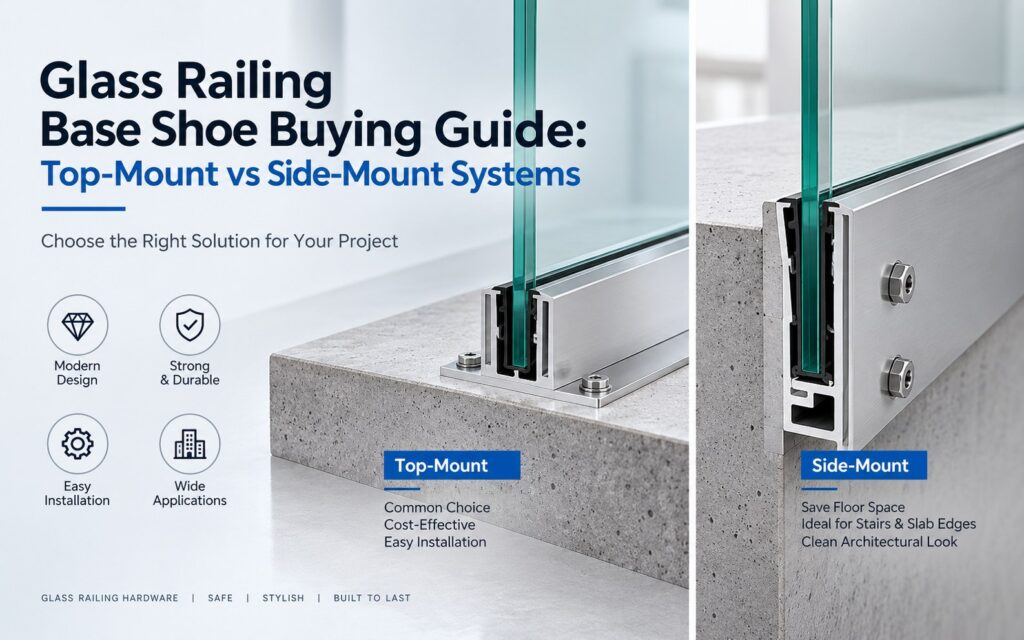
A top-mount glass railing base shoe is fixed directly onto the top surface of concrete, structural steel, or another approved supporting base. The glass is secured inside the aluminum channel using the designed clamping or wedge system.
This is the most common installation method in residential and commercial projects.
Typical Applications for Top-Mount Systems
Top-mount base shoes can be used indoors or outdoors, including apartment balconies, villa terraces, commercial buildings, hotels, and stair landings.
They are practical when there is enough horizontal surface for the channel and fixing bolts. Because installers work from above, positioning, drilling, and leveling are usually straightforward.
3. Why a Top-Mount Glass Railing Base Shoe Is Often the Better Value
For many projects, I recommend top-mount first because the complete solution is usually more economical.
The profile is generally easier to install in a standard layout, and the site does not require as much side access. Labor can also be lower because installers can drill, align, and tighten the system from the top.
For long residential or commercial railing runs, these cost and labor differences can become significant.
Simpler Load Transfer
In many typical installations, a top-mount system has a direct load path into the supporting floor or slab.
However, it is not correct to say that every top-mount system is stronger than every side-mount system. Actual performance depends on profile design, anchors, glass dimensions, substrate, installation quality, and engineering requirements.
4. When Should You Choose a Side-Mount Glass Railing Base Shoe?
A side-mount base shoe is fixed to the vertical face of a slab, stair structure, or supporting edge rather than on top of it.
Its biggest advantage is space saving.
Best for Narrow Stairs and Limited Floor Space
Some staircases are already narrow. A top-mounted channel can reduce usable width and make the stair feel tighter.
In these situations, a side-mount glass railing system moves the glass support to the outside face and preserves more walking area. This is one of the main reasons I would choose side-mount instead of top-mount.
Side-mount can also create a clean edge detail when the design places the glass outside the slab.
5. Why Side-Mount Usually Costs More
The material and labor cost of side-mount systems is usually higher.
Installation may require more difficult slab-edge access, additional positioning work, specialized fixings, and more careful alignment.
Consider Total Installed Cost
When comparing top-mount vs side-mount systems, consider profile cost, anchors, installation labor, edge preparation, access, waterproofing, drainage, and future maintenance.
A lower profile price can still mean a higher installed cost.
6. How Do Glass Railing Base Shoe Systems Compare for Stability?
Both systems can perform well when correctly designed and installed.
A top-mount base shoe often feels like the more straightforward option because the channel sits directly on the supporting surface and can be anchored from above. For standard residential and commercial projects, this is one reason I personally prefer it.
Side-mount systems can also be stable when the side structure, anchors, and installation are properly engineered.
Do Not Judge by Profile Shape Alone
A common customer pain point is comparing profiles only by thickness or appearance. Real stability depends on glass height, glass thickness, anchor spacing, substrate strength, profile design, and installation tolerance.
For project orders, request technical drawings before final approval.
7. Indoor, Outdoor, and Coastal Applications
A glass railing base shoe works well indoors or outdoors, but the environment affects material and finishing decisions.
Many railing projects use aluminum base shoes because they are relatively light, corrosion resistant, and suitable for long continuous railing runs.
For coastal projects, I generally prefer an aluminum base shoe over a stainless steel glass spigot system when the design allows it. The continuous aluminum profile works well for outdoor railings in environments with moisture and salt air, although suitable anchors, drainage, surface treatment, and maintenance remain important.
Outdoor Installation Needs Drainage
Water should not remain trapped around the channel or fixing points. Buyers should review drainage, waterproofing, seal design, and finished floor level before installation, especially on balconies, terraces, pool surrounds, and coastal buildings.
8. Installation: What B2B Buyers Should Check
Installers must mechanically fix the base shoe to the floor, slab, steel structure, or another approved structural base in both top-mount and side-mount systems.
The glass sits inside the aluminum base shoe, so the channel continuously supports its bottom edge.
Top-Mount Installation Checks
Confirm the channel centerline, anchor spacing, slab strength, floor finish thickness, drainage direction, glass alignment, and final railing height.
Side-Mount Installation Checks
For side-mount systems, also confirm edge thickness, vertical fixing surface, access for drilling and tightening, slab condition, and possible interference with finishes.
Accurate leveling is important because small errors become visible across long glass runs.
9. Glass Spigot vs Base Shoe: Related Product Decisions
A glass railing base shoe is not the only frameless glass support method.
A grifo de vidrio is another common option, especially for residential railings and individual panels. Spigots use point supports, while a base shoe supports the glass continuously along the bottom.
Related products can include glass spigots, glass clamps, glass standoffs, accesorios para pasamanos, top rails, and glass connectors. These terms are useful internal-link opportunities.
For projects that also include frameless glass doors, buyers can review our glass door patch fitting buying guide when planning compatible architectural glass hardware.
When minimal visible hardware and lower initial cost are priorities, glass spigots may be attractive. By comparison, for long railing runs or projects that need continuous support and an integrated appearance, a glass railing base shoe may be the better solution.
10. Which System Would I Recommend?
If there is enough installation space, I would normally choose a top-mount glass railing base shoe.
It is the most common option for indoor and outdoor projects and usually offers a better balance of product cost, labor cost, installation simplicity, and stability.
I would choose side-mount when floor or stair width is limited, when the design requires the glass outside the slab edge, or when a top-mounted profile would interfere with usable space.
Final B2B Buying Advice
Before ordering, provide the supplier with railing length, glass thickness and height, mounting preference, substrate type, indoor or outdoor location, coastal exposure, finish requirement, and project quantity.
Do not select the system only from a catalog photo.
The best glass railing base shoe is the one that matches the actual structure, installation space, budget, and environment. In most standard projects, top-mount is my first recommendation, while side-mount remains an excellent solution when saving space is more important than minimizing material and labor cost.